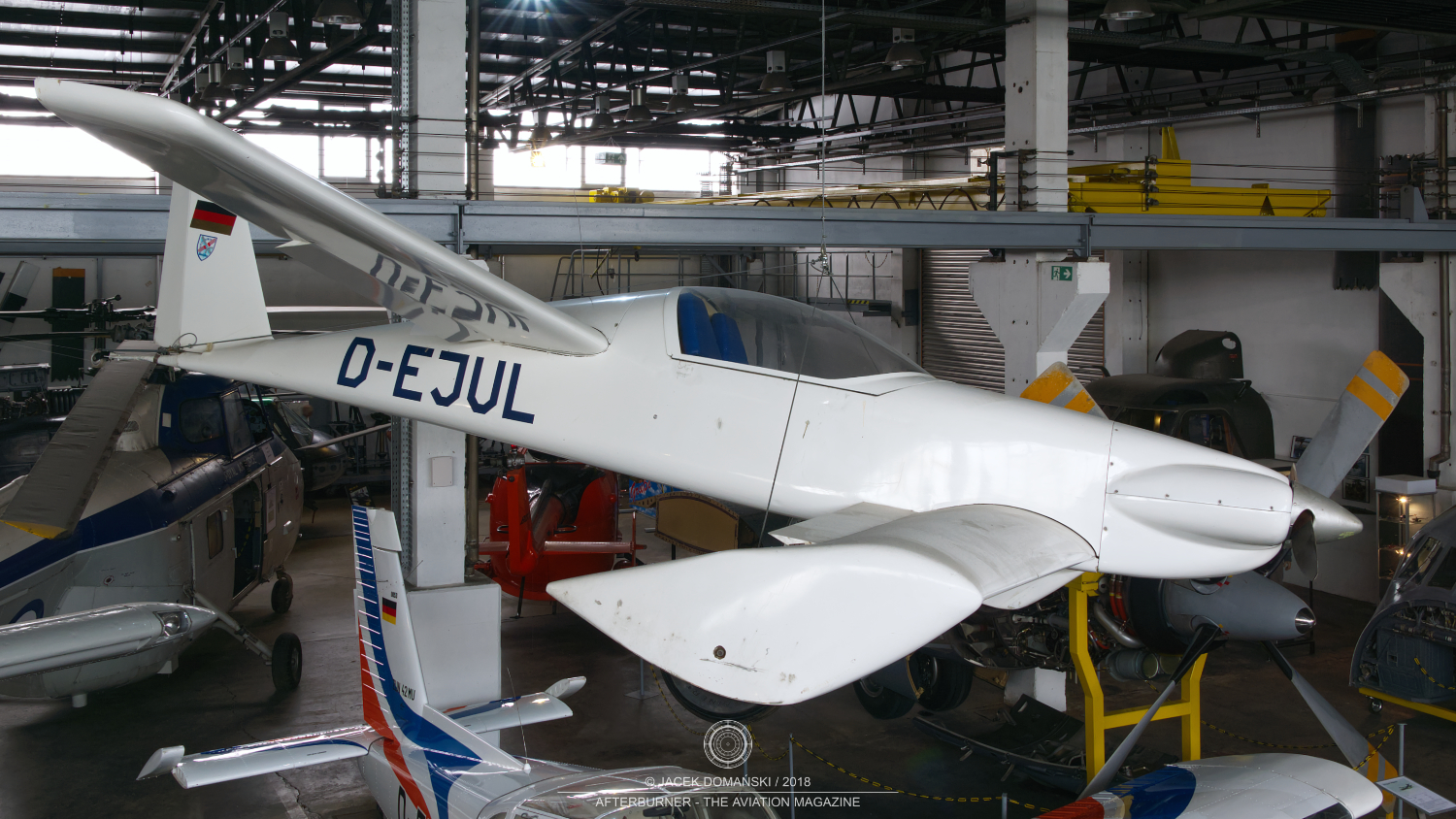
 Viking Dragonfly Mk I (c/n 01/82, D-EJUL), exhibited at Luftfahrtmuseum Wernigerode, June 2018.
The Dragonfly, one of the most interesting amateur-designed light aircraft, performed its maiden flight on 16 June 1980.
The aeroplane was developed by Bob Walters and featured an unusual tandem-wing layout, often regarded as a canard configuration. In the Dragonfly, the forward wing is mounted low at the front part of the fuselage, between the engine and the cockpit, while the aft shoulder wing is located behind the cockpit.
The Dragonfly was made of composite materials and featured a fully enclosed cockpit with two seats in a side-by-side configuration, fixed landing gear, and a single engine in tractor configuration. In the original design, the landing wheels were mounted in fairings at the lower wingtips. This was another unusual feature that characterised the aircraft and required the Dragonfly to operate from paved runways and airfields with wide taxiways.
The Dragonfly concept was based on ideas introduced by Burt Rutan and his Quickie aeroplane. Although, due to its overall layout, the Walters aircraft is often described as a copy of the Quickie 2, the Dragonfly was an independent construction that only drew on the pioneering experience of Rutan Aircraft Factory.
Only a month after its maiden flight, the Dragonfly was presented at the EAA Convention in Oshkosh. The advanced construction of the aircraft was appreciated and it received the Outstanding New Design Award. Consequently, Walters received several requests for Dragonfly plans. Being an active airline pilot, he could not personally handle so many orders; therefore, the licence for the Dragonfly was assigned to the Viking Aircraft company. The aeroplane was offered both as a kit and as plans for homebuilt construction.
In the mid-1980s, Viking Aircraft was acquired by Rex Taylor, the owner of Homebuilt Aircraft Products, Inc. (HAPI), an aviation company specialising in the conversion of Volkswagen engines for aviation purposes. The merger linked the Dragonfly with VW powerplants for many years.
In the following years, several modifications to the original Walters design were introduced. The initial configuration, with wheels mounted in the wing tips, was designated the Mk I. It was followed by the Mk II, equipped with a straight front wing and conventional landing gear. The final variant of the aeroplane was known as the Mk III and featured tricycle landing gear. The Dragonfly was typically powered by a 60 hp air-cooled VW engine.
The Dragonfly featured in our Photo of the Week series was built in Germany and registered as Sünder T1/P Dragonfly in 1983. The aeroplane was modified by a team led by Bernhard Sünder to meet German regulations for amateur-built aircraft. According to information available on the internet, its registration was cancelled in October of the following year. Currently, the Dragonfly is preserved at Luftfahrtmuseum Wernigerode in Wernigerode, Germany (Aviation adventure in the heart of Harz – Luftfahrtmuseum Wernigerode).