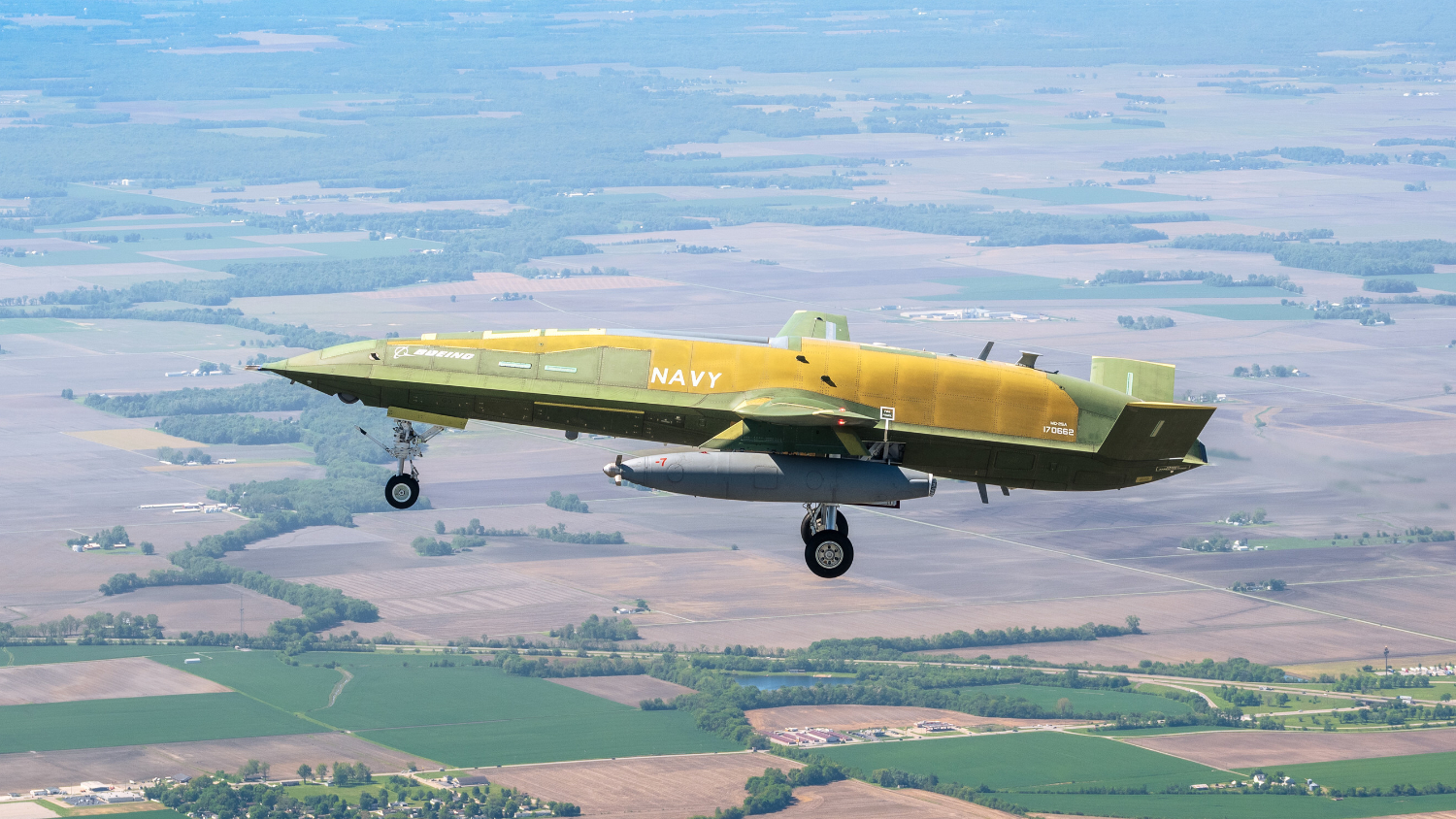
 Boeing and the United States Navy have reached a significant milestone with the first flight of an operational Boeing MQ-25A Stingray. This signals tangible progress towards routine carrier operations and a broader shift in naval aviation.
Lasting around two hours, the sortie showcased the aircraft’s ability to operate autonomously across the full flight envelope – from taxi and take-off to landing – while responding to inputs from the Unmanned Carrier Aviation Mission Control System MD-5 Ground Control Station. The mission was supervised by Boeing specialists and Navy Air Vehicle Pilots from MidAmerica St. Louis Airport, where the programme is headquartered. Once airborne, the Stingray followed a pre-planned profile designed to validate the flight controls, navigation systems and seamless integration of the UAV with its ground control infrastructure.
“Today’s successful flight builds on years of learning from our MQ-25A T1 prototype and represents a major maturation of the programme,” said Dan Gillian, vice president and general manager, Boeing Air Dominance. “The MQ-25A is the most complex autonomous system ever developed for the carrier environment, and this historic achievement advances us closer to safely integrating the Stingray into the carrier air wing.”
Designed as a cornerstone of future carrier aviation, the MQ-25A paves the way for routine integration of unmanned systems on the flight deck, enabling closer cooperation between crewed and uncrewed platforms. Its primary role – autonomous aerial refuelling – will relieve the Boeing F/A-18E/F Super Hornet aircraft from tanker duties, allowing them to focus on strike missions while extending the operational reach of the carrier air wing.
“The first flight of the MQ-25A is a landmark achievement for the Navy-Boeing team and a critical step toward the future of the carrier air wing,” explained Tony Rossi, who leads the Program Executive Office for Unmanned Aviation and Strike Weapons. “This flight demonstrates our progress in delivering a carrier-based refuelling capability that will significantly extend the reach and lethality of our fleet.“
The aircraft involved is the first of four Engineering Development Model examples to be delivered under the Navy’s $805 million Engineering and Manufacturing Development contract.
“Watching our first Navy aircraft complete an autonomous flight underscores what disciplined teamwork and rigorous testing deliver,” said Troy Rutherford, vice president of the MQ-25 programme. “Today would not have been possible without the hard work and dedication of our Boeing, Navy, and industry team. Together, we are redefining the future of naval aviation and pushing the boundaries of what’s possible with autonomy.”
Further test flights are set to continue from MidAmerica, focusing on expanding the validation envelope before the programme transitions to Naval Air Station Patuxent River, where preparations for carrier-based trials will begin.
Cover photo: The first operational U.S. Navy MQ-25A Stingray soars over southern Illinois during a successful two-hour first flight on April 25 (Boeing Photo by Eric Shindelbower).
All photos and quotations © Boeing. Information from the Boeing company press releases were used.