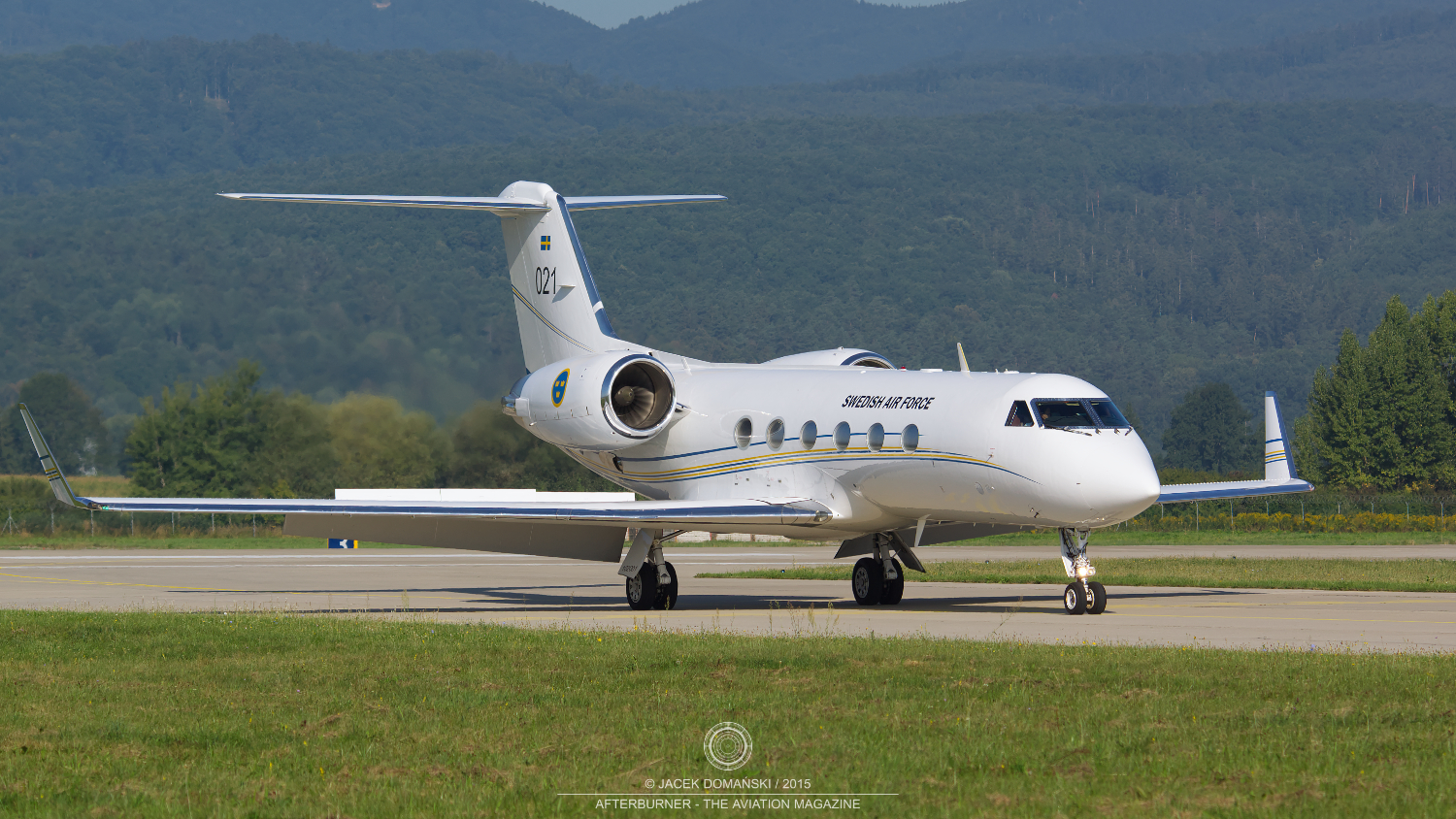
 Gulfstream IV (c/n 1014, “021” of Flygvapnet / the Swedish Air Force), taxiing to the apron at Sliač Air Base, Sliač, August 2015.
The story of the business aircraft manufactured by Grumman and marketed under the Gulfstream brand began in the late 1950s with the Gulfstream I, a twin-turboprop aircraft internally designated as the G-159.
The first aircraft from the Gulfstream family performed its maiden flight on 14 August 1958. Serial production began the following year. This cantilever low-wing monoplane was powered by two Rolls-Royce Dart engines and was built in 200 examples before production ceased in 1969.
In the mid-1960s, small business jets began to dominate the executive transport market. Recognising the new trend, Grumman quickly launched the development of its first jet-powered business aircraft. Designated the Gulfstream II and powered by two Rolls-Royce Spey turbofan engines, the aeroplane made its maiden flight on 2 October 1966.
The GII was a cantilever low-wing monoplane equipped with swept wings and a swept T-tail. Its Spey engines were mounted on aft fuselage pylons. The jet was operated by a crew of two and could carry up to nineteen passengers.
In 1967, Grumman opened a new factory in Savannah, Georgia, to manufacture the Gulfstream II. It was also a significant milestone in the company’s history, as the opening of the new plant was linked to the separation of Grumman’s civil and military aircraft divisions. Production of the jet continued until the end of 1979, with more than 250 examples built.
In the 1980s, the GII was succeeded by a new generation of Grumman business jets, the Gulfstream III. The aircraft performed its maiden flight on 2 December 1979 and received its type certificate from the Federal Aviation Administration in September the following year.
The Gulfstream III programme also marked another significant change in the company’s structure. First, the aforementioned civil aircraft division merged with American Jet Industries. Then, in 1978, the Savannah factory was sold and, shortly afterwards, the new company known as Gulfstream American was established.
Production of the GIII, an upgraded version of its predecessor, continued until 1986, with over 200 examples manufactured. In addition, approximately forty GII aircraft were converted to the Gulfstream IIB standard, incorporating the new wings and avionics of the GIII.
In 1982, while still manufacturing the GIII, the company was renamed Gulfstream Aerospace Corporation. In March of the following year, it launched development of the Gulfstream IV. The new project attracted considerable investor interest and, as a consequence, Gulfstream was acquired by Chrysler Corporation in 1985.
The Gulfstream IV was much more than just another modernisation of the previous design. The aircraft featured improved aerodynamics, redesigned wing and fuselage structures, as well as a number of modifications intended to reduce weight, increase range and minimise cruise drag.
The GIV was powered by two Rolls-Royce Tay medium-bypass turbofan engines, each generating 12,420 lbf (55.2 kN) of thrust. It also became the first business jet to feature a fully glass cockpit.
On 19 September 1985, the Gulfstream IV successfully completed its maiden flight. In April 1987, the aircraft received FAA certification and entered service shortly afterwards.
In 1989, Gulfstream was bought back from Chrysler by Allen Paulson, the former CEO of Gulfstream American. The company continued to develop the GIV family. In the early 2000s, two new variants were introduced: the lengthened G450 and the short-range G350.
Production of the Gulfstream IV family continued until early 2018, with more than 900 aircraft built, including 356 examples of the upgraded G450.
In the 1990s, the Swedish Air Force acquired three Gulfstream IV aircraft. The first was purchased in 1992 and assigned to VIP transport duties, including transportation of members of the Royal Family and the Prime Minister. The aircraft featured in our Photo of the Week series was locally designated TP102A and remained in active service until 2017.
Then, in either 1995 or 1997, depending on the source, two additional Gulfstream IV aircraft were acquired. Designated S102B Korpen (“Raven”), they were modified GIV-SP aeroplanes used for signals intelligence (SIGINT) missions.
In the early 2000s, two more GIVs were acquired for VIP transport duties and were given the designations TP102C and TP102D. The latter remained in operational service until 2026 and is to be replaced by the Bombardier Global 6500, acquired by Flygvapnet in June of that year.