 At this year’s International Space Summit in Paris, French President Emmanuel Macron presented an ambitious vision for Europe’s future in space. As we reported in one of our previous articles, within two years, he wants to see the European Nyx cargo spacecraft dock with the International Space Station (ISS). Within five years, he wants to see the Argonaut lunar lander reach the surface of the Moon. And within ten years, he wants to see the first European crewed spacecraft lift off from the Guiana Space Centre in Kourou. But how close is Europe to turning these ambitions into reality — and what capabilities does it still need to develop?
Europe would not be starting from scratch. Over several decades, the European Space Agency (ESA) and European industry have accumulated extensive experience in space transportation and human spaceflight. Europe operates its own launch systems, developed the Automated Transfer Vehicle (ATV) for missions to the ISS and continues to operate Columbus, the station’s European laboratory module.
Europe also provides the European Service Module (ESM) for NASA’s Orion spacecraft, launched aboard the Space Launch System (SLS) as part of the Artemis programme. The module has successfully supported both Artemis I and Artemis II, providing Orion with propulsion, power and thermal control, as well as air and water for the crew during the latter mission. Together, these programmes have given Europe expertise ranging from launch systems and orbital operations to autonomous rendezvous and docking, propulsion and life-support technologies. What Europe still lacks is a complete system capable of carrying its astronauts into orbit independently.
Europe has attempted to fill this gap before. In 1987, ESA approved Hermes, a crewed spaceplane intended to provide independent access to space aboard the then-developing Ariane 5. The programme was cancelled in 1992 after rising costs, increasing vehicle mass and repeated delays meant its cost and performance goals could no longer be met. Its cancellation effectively ended Europe’s first serious attempt to establish an independent crew transportation capability.
Today, the most immediate of Macron’s three milestones concerns Nyx, a reusable spacecraft being developed by The Exploration Company. In September 2026, ESA signed a contract worth up to €760 million under the ALADDIN programme to establish an autonomous European capability to transport cargo to and from low Earth orbit (LEO). The agreement covers development and demonstration of the complete system, including a mission to the ISS, where Nyx is expected to autonomously dock before returning to Earth.
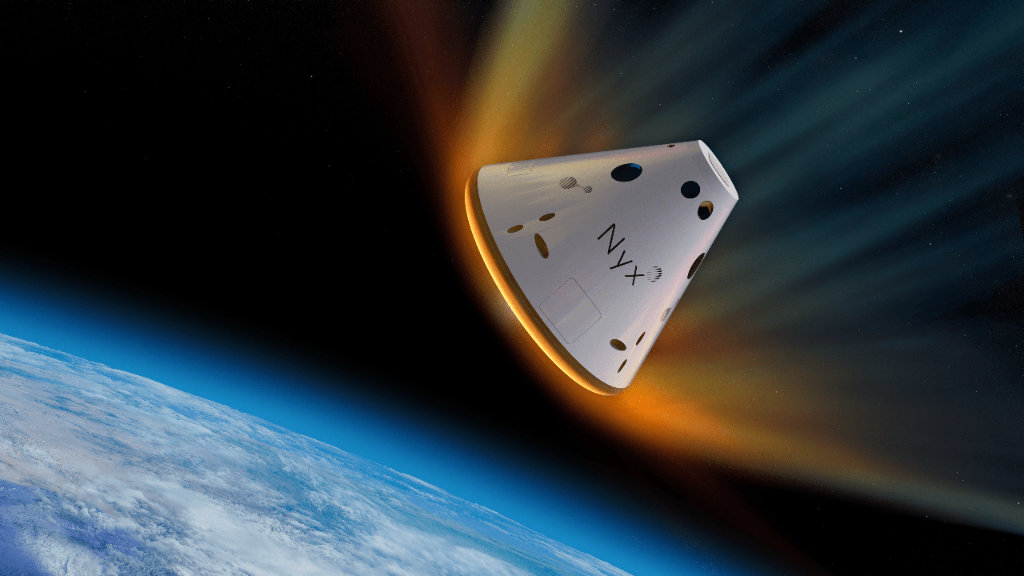
Nyx could also provide some of the technological foundations for future European crew transportation. ESA’s exploration strategy identifies autonomous cargo transportation as a way of securing technologies that could later support a crewed vehicle, while The Exploration Company has begun work related to a future crewed version of Nyx. However, Nyx Crew is not an approved ESA programme, nor has it been selected as Europe’s future crew transportation system.
Macron’s second milestone is considerably more tangible. Argonaut is already an established ESA programme intended to give Europe autonomous access to the lunar surface. Its Lunar Descent Element is being developed by a European consortium led by Thales Alenia Space Italy, while Ariane 64 — the more powerful, four-booster variant of Europe’s Ariane 6 heavy-lift launcher — has been selected to launch it. Argonaut is designed to deliver around 1.5 tonnes of cargo to the Moon in support of robotic missions and future human exploration, including NASA’s Artemis programme. ESA expects its first mission to launch in 2030, broadly matching Macron’s five-year ambition.
The third and most ambitious milestone remains much less defined. ESA is studying options for future European crew transportation, but no programme to develop an independent crew spacecraft has been approved. The declaration adopted by ESA Member States at the Paris summit acknowledged that a competitive European astronaut transportation capability would represent a further step towards greater autonomy in LEO but stopped short of committing to such a programme. Instead, ESA was tasked with preparing options for consideration by ministers in December 2026.
A spacecraft would be only part of the challenge. An independent system would also require human-rating of the vehicle and launcher, together with appropriate ground infrastructure, mission operations and recovery capabilities. Ariane 6 provides Europe with independent access to orbit but was not designed as a crew launcher and is not human-rated. ESA has previously indicated that it could be adapted for human spaceflight, making a human-rated Ariane 6 one possible route. Another would be the development of a new suitable European launcher.
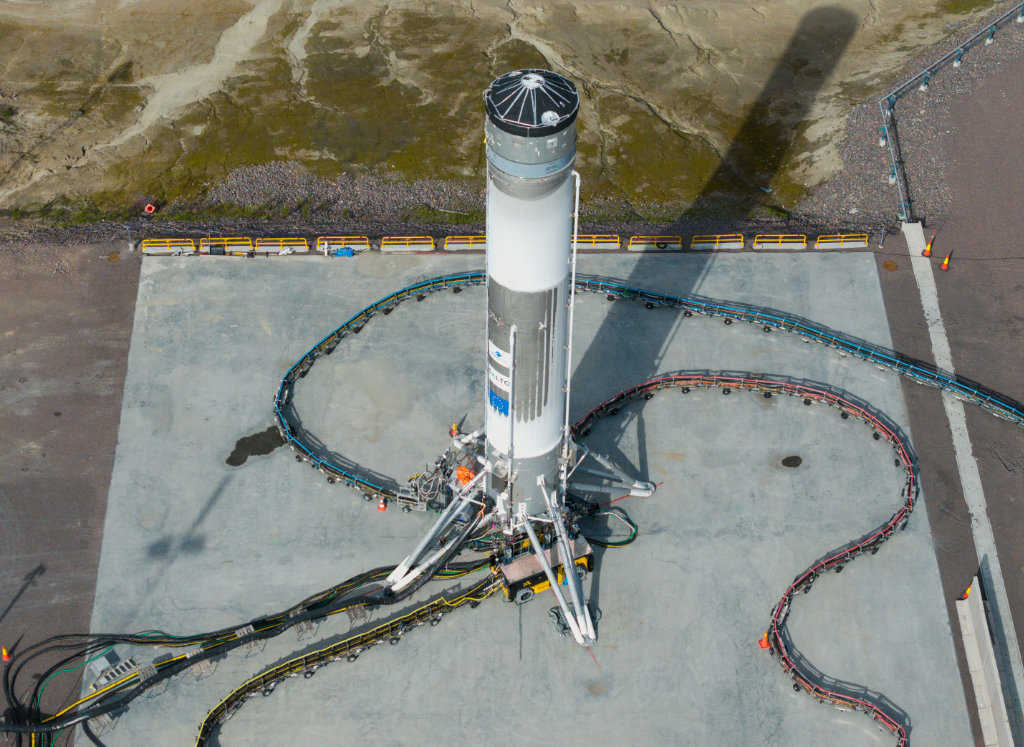
Europe is already investing in technologies that could shape such future launch systems. ESA’s Themis programme is preparing flight tests of a reusable rocket-stage demonstrator powered by the methane-fuelled Prometheus engine, developing technologies for vertical take-off and landing, recovery and reuse. Through its Pathfinder activity, ESA is also studying a European very-heavy reusable launcher capable of carrying up to 60 tonnes into LEO, partly with future human and robotic exploration in mind. Meanwhile, the European Launcher Challenge is supporting new commercial launch providers, although the vehicles currently involved are primarily small and medium rockets. None currently represents an approved European crew launcher, leaving the vehicle that might eventually carry astronauts from Kourou an open question.
Europe therefore possesses many of the individual capabilities needed for independent crew transportation. Nyx is expected to demonstrate autonomous cargo transport to and from LEO, while ATV, Columbus and Orion’s ESM provide a substantial technological foundation. What is missing is a programme bringing such capabilities together specifically to transport European astronauts independently. Macron’s ten-year milestone therefore depends less on starting from scratch than on turning existing expertise and emerging technologies into a complete system.
Human spaceflight represents only one part of the broader technological independence outlined by Macron in Paris. He also emphasised critical space-based capabilities including Earth observation, positioning and secure communications. Here Europe has considerably stronger foundations: Galileo provides independent global satellite navigation, while Copernicus provides extensive Earth-observation capabilities now being renewed and expanded with new generations of Sentinel satellites. IRIS², intended to provide sovereign and secure satellite communications, entered full-scale implementation in August 2026, with the first launches planned from 2029. Together with Europe’s independent launch capabilities, these programmes show that greater space autonomy is already well advanced in several key areas.
Independent human access is also becoming increasingly relevant as the ISS era approaches its end around 2030, after which NASA and its partners intend to transition towards commercially operated platforms in LEO. Europe is also preparing for this transition through partnerships with companies developing future stations. Without its own crew transportation system, however, European astronauts would still depend on non-European spacecraft to reach them.
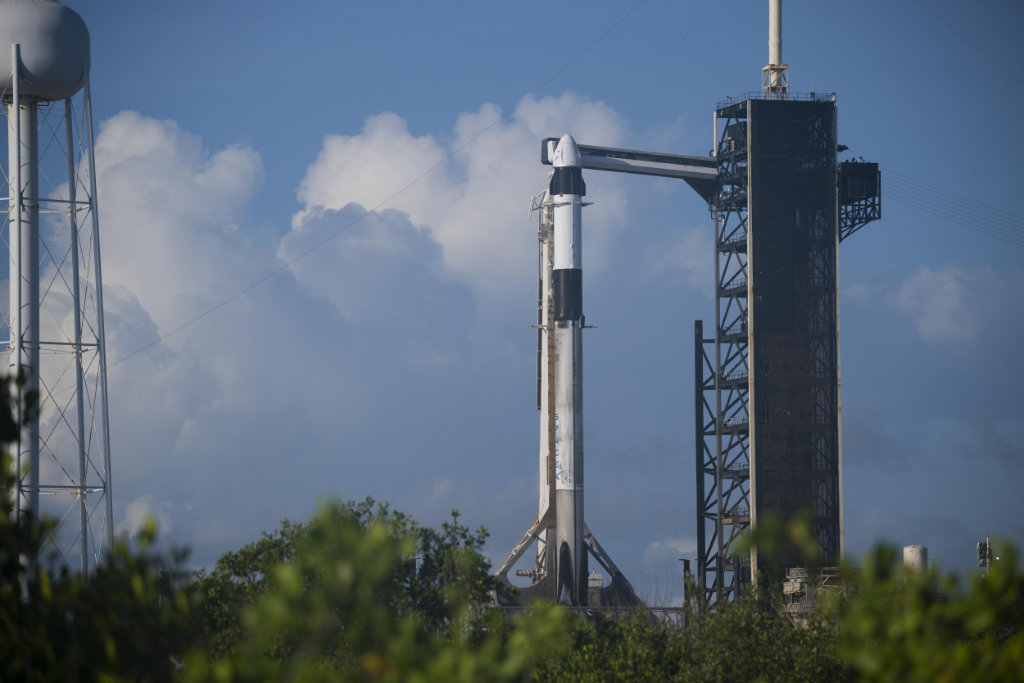
ESA’s planned European Pathfinder Innovation & Commercialisation (EPIC) mission illustrates this dependence. The current concept foresees ESA acquiring a Crew Dragon mission in the first quarter of 2028 for a medium-duration flight to the ISS, in cooperation with interested international partners. Rather than purchasing individual seats, ESA would procure the complete mission, gaining greater control over how it is organised and used — but not independent access to orbit.
This dependence does not pose an immediate threat to European human spaceflight. Crew Dragon is a proven operational system, and NASA has recently contracted additional SpaceX crew rotation missions, although further flights may still be required to maintain regular ISS transportation until around 2030. Beyond that, the landscape is less certain. SpaceX is developing Starship as its next-generation cargo and human spaceflight system, while Boeing’s Starliner — intended to provide NASA with a second independent crew transportation system — continues to face significant technical challenges. During its first crewed test flight to the ISS in 2024, propulsion problems led NASA to return Starliner without its two astronauts, who eventually returned aboard Crew Dragon several months later. Starliner remains uncertified for regular crewed missions, with another uncrewed test planned before a possible return to crewed operations in 2028. For Europe, this illustrates a broader strategic issue: access to LEO ultimately depends on spacecraft, launch systems and development decisions controlled by external partners.
Macron’s three milestones therefore represent very different levels of technological and programme maturity. The two-year objective is tied to Nyx, already under development within a funded ESA cargo programme. The five-year objective builds on Argonaut, an established lunar programme with an industrial team and launcher selected. The ten-year objective is fundamentally different: Europe has many of the technologies, industrial capabilities and operational experience that could contribute to independent crew transportation, but no such programme has been approved. It is therefore the milestone most dependent on political decisions and sustained investment over the coming years.
Whether Macron’s vision becomes reality will depend not only on technological progress, but on whether Europe is prepared to turn its capabilities into long-term programmes of its own. It already possesses much of the industrial and technological expertise required to play a larger role in human and robotic exploration; what it does not possess is independent human access to space. With the ISS era approaching its end and a new commercial landscape emerging in LEO, choices made over the next few years may determine whether Europe enters that era primarily as a customer of foreign transportation systems or eventually as an operator of its own.
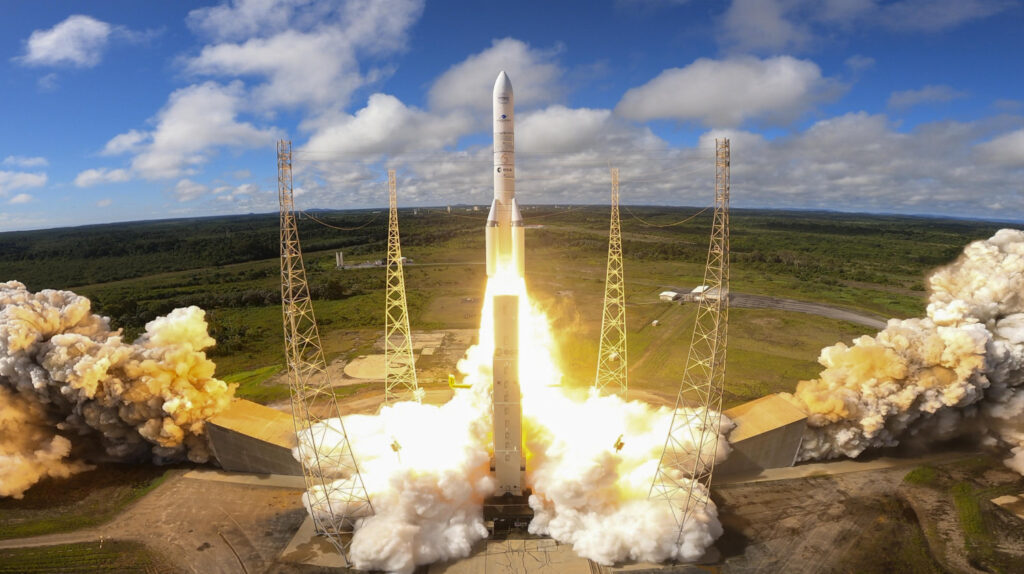
Cover photo: First Ariane 6 liftoff with most powerful boosters (photo: ©ESA – S. Corvaja)
ESA, NASA and Élysée Palace press materials were used.