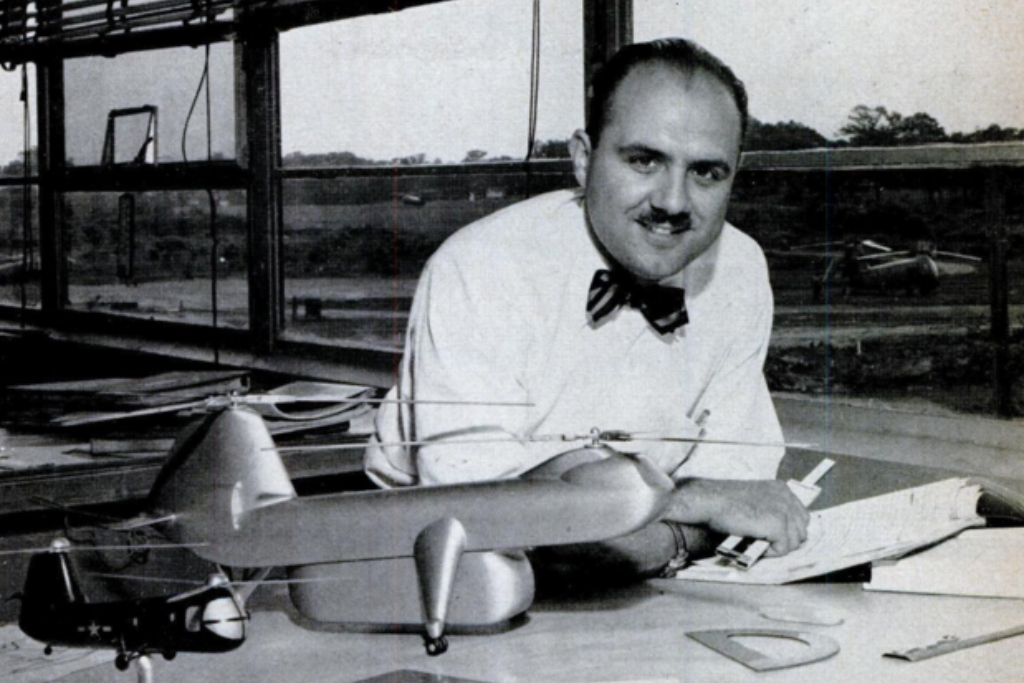
 Frank Nicholas Piasecki, an American engineer and pioneer of rotorcraft aviation, was born on 24 October 1919, in Philadelphia, Pennsylvania.
The son of Polish immigrants, Piasecki became interested in rotorcraft at an early age. During his high school years, he worked in an autogyro workshop and later studied mechanical engineering at both the University of Pennsylvania and New York University. After working for the Platt-LePage Aircraft Company, he founded the PV Engineering Forum in 1940 together with his former classmate Harold Venzie.
Piasecki’s first major project was the PV-2, which made its maiden flight in 1943 and featured several innovative solutions. Its advanced design attracted the attention of the US Navy, and Piasecki subsequently received a development contract. In January 1944, he started working on a series of naval helicopters and ultimately developed the world’s first successful tandem-rotor design.
Designated the PV-3 (XHRP-X by the US Navy) and commonly known as “The Dogship”, the helicopter made its first flight on 7 March 1945. Despite its success, the PV Engineering Forum faced financial difficulties, forcing Piasecki to sell a controlling 51% interest in the company. In 1946, it was reorganised as the Piasecki Helicopter Corporation.
The PV-3 entered serial production in 1947 as the HRP-1 Rescuer, earning the nickname “Flying Banana” due to its distinctive silhouette. Piasecki continued to develop the tandem-rotor concept, producing the HRP-2 and the PV-14/PV-18. The latter entered service with the US Navy and US Army as the HUP-1 Retriever and H-25 Army Mule.
His most ambitious early development was the YH-21, an all-metal derivative of the HRP-1 developed for the United States Air Force. Following its maiden flight on 11 April 1952, it entered serial production as the H-21 Workhorse/Shawnee. More than 700 examples were built and operated by military forces in several countries.
However, the success of the H-21 coincided with a turning point in Piasecki’s career. In 1956, he lost the confidence of the company’s major shareholders and was forced to leave the enterprise he had founded. Soon afterwards, the Piasecki Helicopter Corporation was renamed Vertol.
Piasecki did not abandon his vision of advanced rotorcraft. He established the Piasecki Aircraft Corporation, rehired some members of his former design team and continued developing experimental military rotorcraft. His later projects included the PA-59 Airgeep, PA-39 quad-rotor helicopter, PA-97 Helistat and the innovative compound helicopters 16H-1 and X-49.
Frank Piasecki died on 11 February 2008, aged 88. His second company, Piasecki Aircraft Corporation, has survived to this day and is managed by his sons, continuing his work on innovative rotorcraft, including electrically powered helicopters and unmanned aerial systems.
Cover photo: Frank Piasecki in 1951 (photo: Wikipedia, Public Domain)