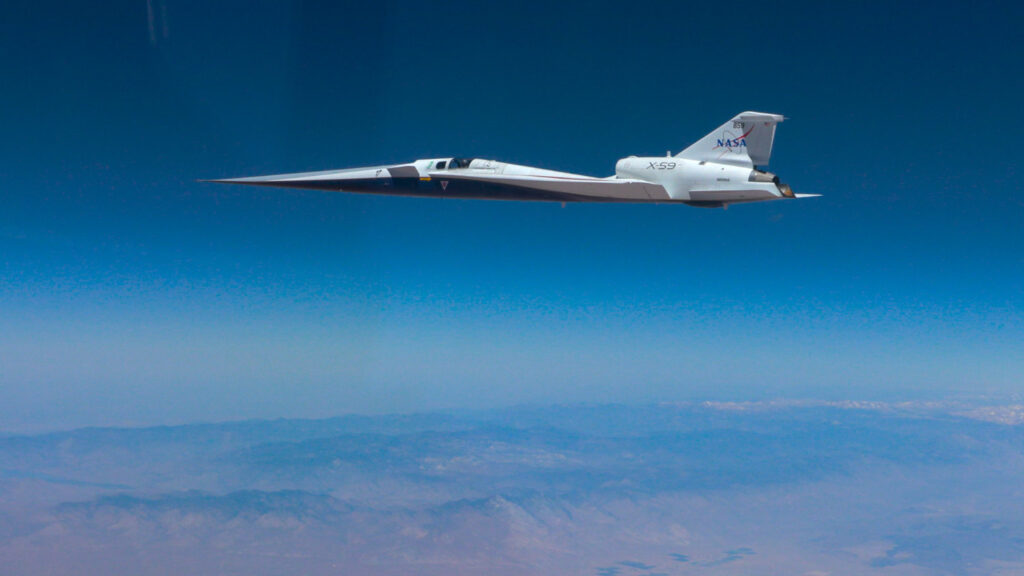
 On Friday, 5 June 2026, NASA’s X-59 experimental aircraft reached a major milestone by flying faster than the speed of sound for the first time.
During the 81-minute flight, the X-59 performed as expected, achieving a speed of Mach 1.1 (approximately 1,147 kph or 713 mph) at an altitude of 43,400 ft (13,228 m). For NASA test pilot Jim “Clue” Less, who piloted the experimental aircraft, the instruments were the only indication that the aeroplane was flying at supersonic speed. That was exactly what the project team had hoped for.
“You know you are supersonic when gauges say you are supersonic. I didn’t feel anything,” said the pilot, adding: “It went smoothly, and we easily got to Mach 1.1.”
The X-59 is the key component of NASA’s QueSST (Quiet Supersonic Technology) mission, which aims to enable quieter supersonic flight and paves the way for commercial supersonic aerial operations over land.
The X-59 is designed to fly at supersonic speeds while generating only a quiet thump rather than the loud sonic boom typically produced by conventional aircraft when breaking the sound barrier. During this flight, however, a NASA F-15 chase aircraft assisted the X-59 and monitored the test. The sonic booms produced by the F-15 drowned out any sound made by the X-59. During a later phase of testing, the X-59 will conduct flights focused specifically on evaluating its sound profile.
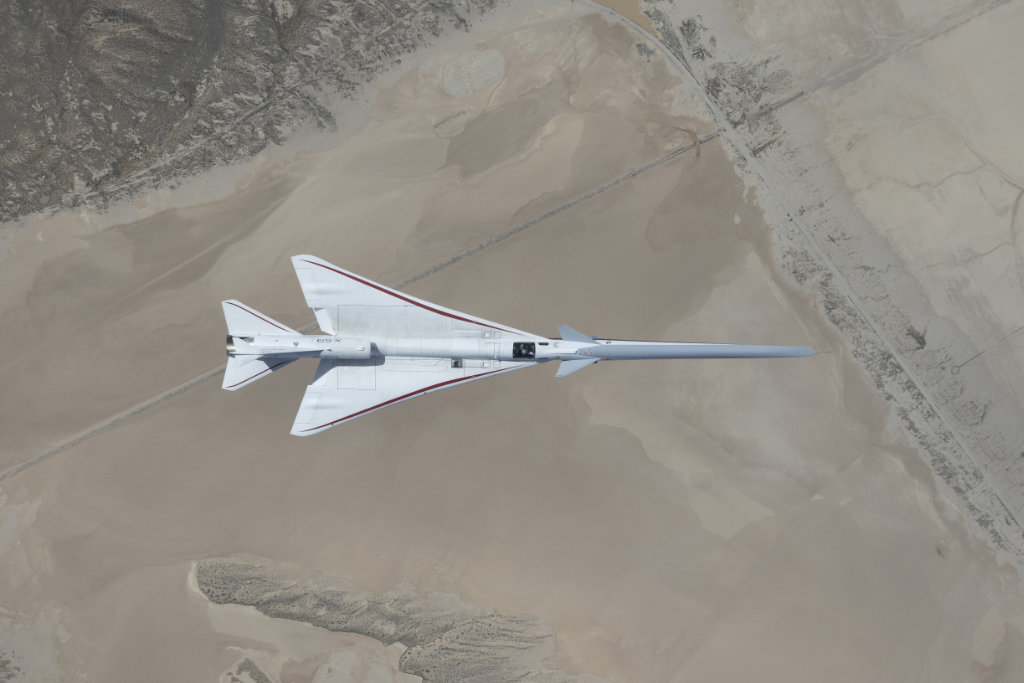
Now, that the X-59 has officially commenced supersonic flight testing, the next significant milestone will be its first mission-conditioned flight. During this test, the aircraft will fly at the same speed and altitude as is planned for future community response missions. It will reach a speed of Mach 1.4 (about 1,488 kph or 925 mph) and an altitude of 55,000 ft (16,764 m) while flying over several communities across the US. The goal is to collect data from people on the ground regarding the noise levels generated by the X-59 aircraft flying overhead.
“The plane wants to go faster, and we are looking forward to that,” concluded Jim “Clue” Less.
Interestingly, this flight was also the first time the X-59 appeared on NASA’s flight tracker. That implies that from now on, it may be possible to track it there on a regular basis.
If you’d like to find out more about the X-59 test aircraft and NASA’s QueSST mission, please check our previous articles on the subject:
- NASA X-59 Quiet Supersonic Aircraft officially revealed;
- X-59 QueSST aircraft successfully completes its maiden flight;
- NASA’s X-59 advances flight test campaign with the second and third flights.
Cover photo: NASA’s X-59 Quiet Supersonic Technology experimental aircraft during its first supersonic test flight on 5 June 2026. (Source: ©NASA/Lori Losey)
In this article, press releases and other materials of the National Aeronautics and Space Administration were used. All photos and quotations © National Aeronautics and Space Administration.