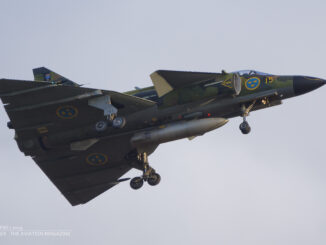
On 25 October 1955, the prototype of the Saab 35 Draken, a Swedish supersonic interceptor, performed its maiden flight. Designed to counter the growing threat posed by high-altitude jet bombers and to meet the demanding requirements of the Swedish Air Force, the aircraft was capable of operating from rough runways, public roads and temporary air bases.
One of the most distinctive features of the new fighter was its double-delta wing configuration. To evaluate this unconventional design, Saab first built a scaled-down experimental aircraft, designated Saab 210 and nicknamed Lilldraken (Little Dragon). Its maiden flight took place on 21 January 1952, and the subsequent test programme comprised 887 flights, providing valuable experience for the development of the full-sized interceptor.
The first production version, designated the J 35A, was ordered in 1956, and the Draken entered service with the Swedish Air Force in March 1960. The aircraft eventually became a successful supersonic fighter, with successive variants serving in Sweden and export versions operated by Denmark, Finland and Austria. The Danish aircraft were particularly distinctive, having been adapted for close air support missions.
Although the Swedish Air Force retired the Draken in 1999, the aircraft’s flying career continued into the following decade. Today, two airworthy examples remain in Europe, operated by the Swedish Air Force Historic Flight.
More information about the development and operational history of the Saab 35 Draken can be found in our full article, Saab SK 35C Draken.