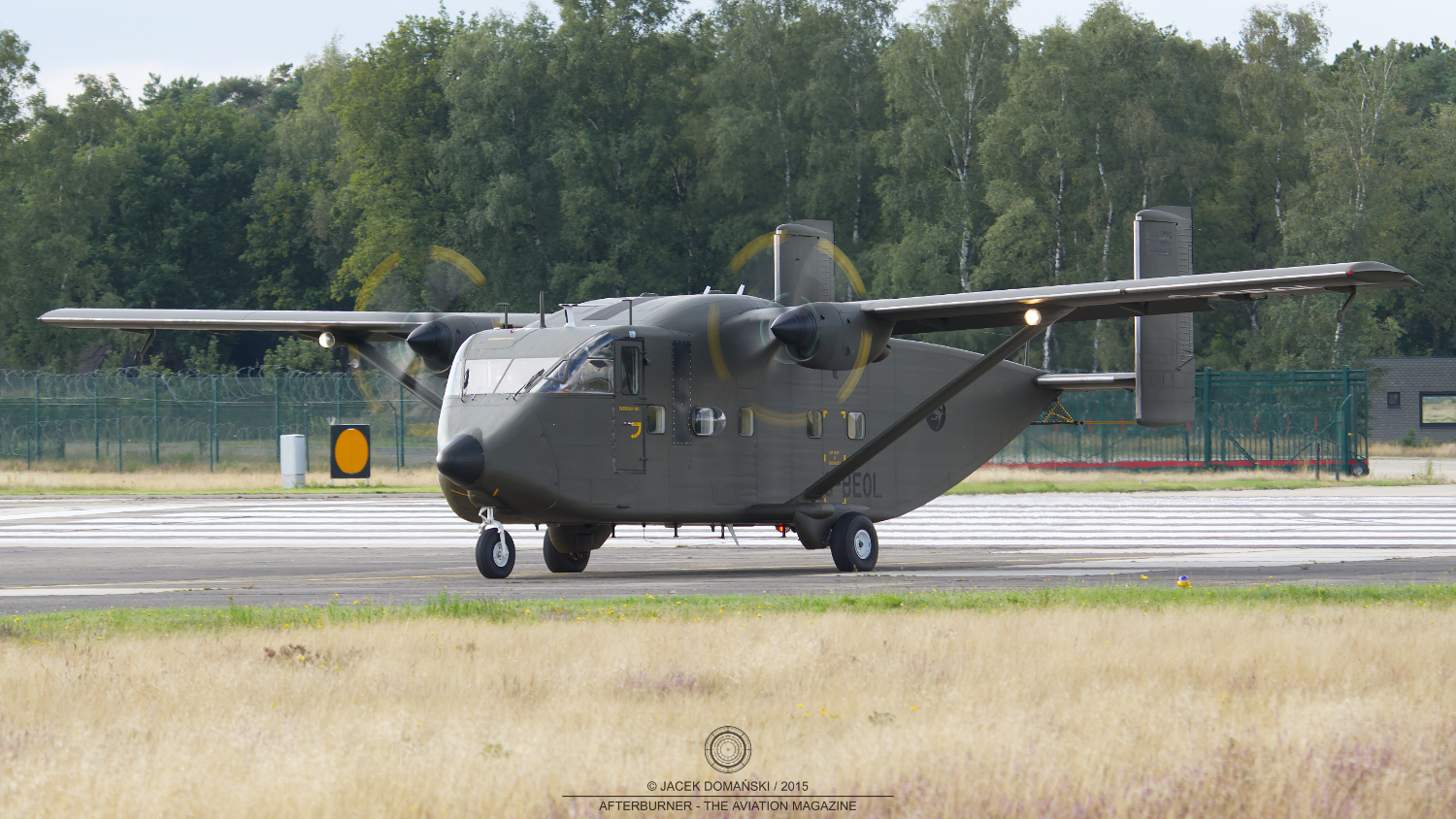
 Short SC.7 Skyvan (c/n SH.1954, G-BEOL, formerly JA8803 of the Japan Maritime Safety Agency), taxiing after landing at Kleine-Brogel Air Base, September 2015.
The story that led to the development of the Short SC.7 Skyvan, commonly nicknamed the “Flying Shoebox”, began in the mid-1940s. At the end of the Second World War, George Herbert Miles designed a short-range, low-cost transport aircraft known as the Miles M.57 Aerovan. The aeroplane was intended for the British Army, but the Air Ministry showed no interest in supporting the project, and development of the Aerovan was put on hold.
The M.57 performed its maiden flight in January 1945. The following year, Miles Aircraft launched serial production of the Aerovan. The aircraft was expected to be a commercial success. However, in 1947 the company declared bankruptcy, and production of the M.57 ceased after approximately fifty examples had been built.
In 1948, Frederick George Miles, a brother of G.F. Miles, founded F.G. Miles Limited, a company established to continue producing aircraft under the Miles brand. A couple of years later, the company began cooperating with Maurice Hurel, a French aircraft designer who focused on the development of high-aspect-ratio wings and their application to transport aircraft.
One example of the Miles Aerovan Mk 4 was rebuilt with a Hurel-designed wing featuring an aspect ratio of 20.5:1 and supported by lifting struts. The new aeroplane, designated the Hurel-Dubois Miles HDM.105, performed its maiden flight in March 1957.
The new design seemed promising, and a new joint company named H.D. et M Aviation Ltd. was founded to continue its development and subsequently launch serial production of the aircraft. Now known as the HDM.106 Caravan, the aeroplane was intended to be a twin-engine, all-metal transport aircraft equipped with a very high-aspect-ratio wing. However, the HDM.106 project never progressed beyond the drawing board.
In June 1958, the prototype of the HDM.105 was damaged beyond repair in a landing accident. Later that year, Miles proposed the design to Short Brothers.
Short acquired the project, along with the conclusions drawn from the HDM.105 prototype evaluation. However, the company rejected the original design and, shortly afterwards, redeveloped the concept into the Short SC.7 Skyvan – a twin-engine, all-metal aircraft known for its distinctive box-like appearance.
The SC.7 was a high-wing, short-haul transport aircraft equipped with a high-aspect-ratio wing. However, in comparison with Hurel’s design, its aspect ratio was reduced to 11:1. The aeroplane featured a large rear cargo door, a square-section fuselage, and twin fins and rudders.
The first prototype of the Skyvan, powered by two Continental piston engines, successfully completed its maiden flight on 17 January 1963. Shortly afterwards, the aircraft was fitted with two 520 shp Turbomeca Astazou II turboprop engines.
Although aimed at a relatively narrow group of customers, the aeroplane became a commercial success. The Skyvan was well received by freight operators thanks to its large rear cargo door and, for the same reason, became an ideal aircraft for parachuting, skydiving and air-to-air photography. In addition, the SC.7 was also used for aerial spraying and by NASA for the aerial recovery of parachute-borne payloads.
The Skyvan was operated by numerous military and civilian operators around the world. Production of the SC.7 ceased in 1986, with a total of 149 aircraft built.
The SC.7 Skyvan G-BEOL, featured in our Photo of the Week series, was built in 1977. It represents the Skyvan 3 variant, powered by Garrett TPE331 engines, the most widely produced version of the aircraft. The aeroplane initially served with the Japan Maritime Safety Agency before being sold to a private operator. In 2000, the aircraft was acquired by Invicta Aviation and registered as G-BEOL. It later appeared in the film Kingsman: The Secret Service (2014) as a skydiving platform.
In 2019, the aeroplane was purchased by the Guyana Defence Force, together with another used example (c/n SH.1943, formerly G-PIGY). The aircraft were registered as 8R-GWJ and 8R-GBW; however, there is contradictory information regarding which registration was assigned to which serial number.
Nevertheless, according to Guyana Chronicle, one of the aircraft became operational for less than a month. The second Skyvan, most probably the pictured SH.1954, was still in service at the end of 2025.