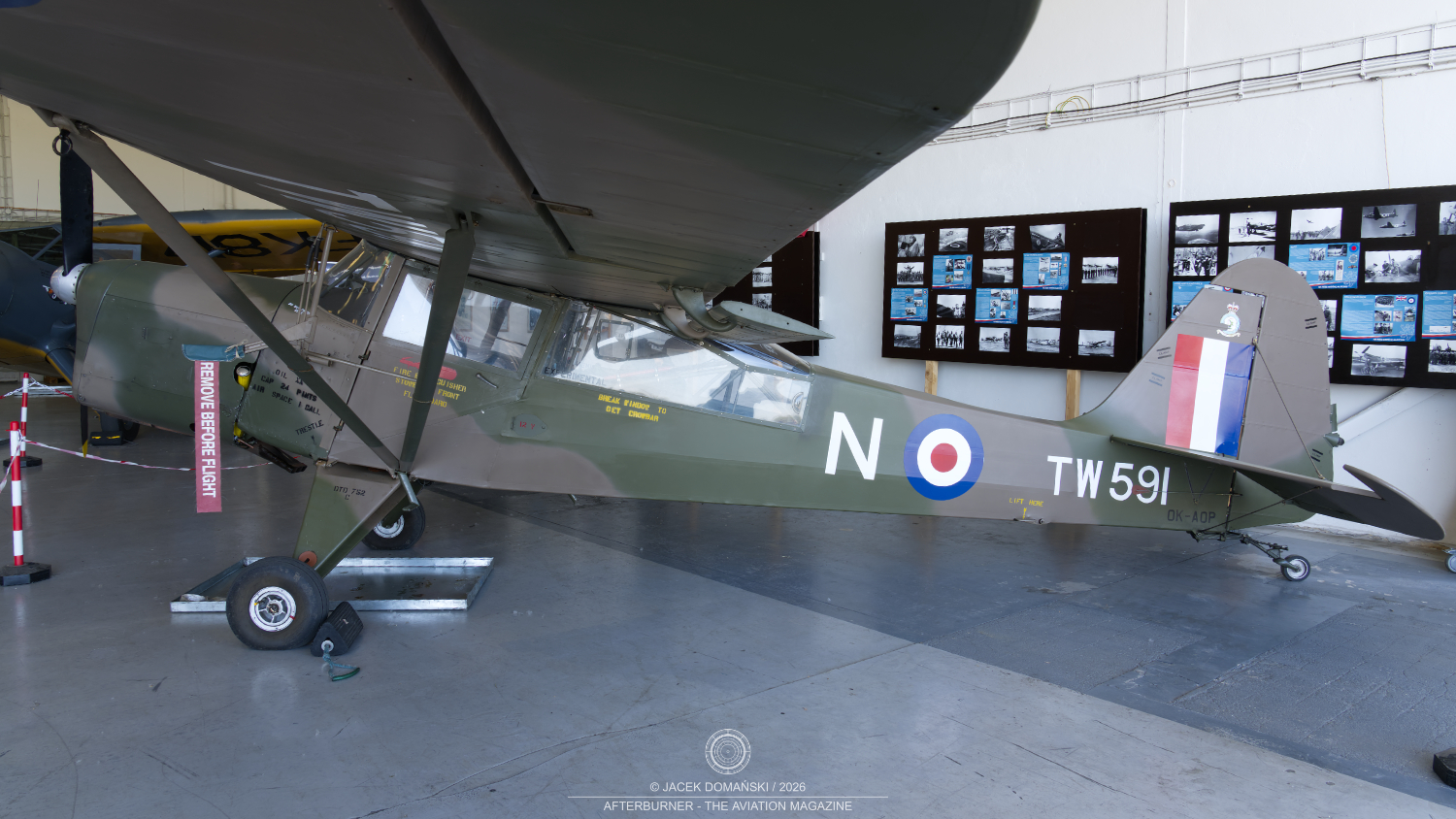
 Auster AOP.6 (c/n 2463, OK-AOP, formerly TW591 of the Royal Air Force and G-ARIH), exhibited during the open day at the Classic Trainers / Hangar 3 collection, Plzeň-Líně Airfield, May 2026.
The Auster AOP.6, also known as the Auster Model K, was developed by Auster Aircraft Limited in the mid-1940s. The aircraft was intended as the successor to the Taylorcraft Auster Mk V, a light utility aircraft used by the British Armed Forces during the Second World War as an Air Observation Post (AOP) aircraft for directing artillery fire.
The new aircraft retained the basic concept of the Auster Mk V, featuring a high-wing configuration, fixed undercarriage and a two-seat cockpit. However, it incorporated a strengthened fuselage and was powered by a 145 hp de Havilland Gipsy Major 7 engine. Visually, the AOP.6 could be distinguished from its predecessor by its longer undercarriage legs (required to accommodate the larger propeller) and external, non-retractable aerofoil flaps.
The AOP.6 made its maiden flight on 1 May 1945 and, shortly afterwards, the Royal Air Force placed an initial order for 296 aircraft. A second production batch was ordered in 1952, bringing the total number of aircraft produced to approximately 380.
In addition to the standard AOP variant, a dual-control training version was later developed. Designated the Auster T.7 (or the Auster Model Q), it was built in approximately eighty examples.
Initially, the AOP.6 was acquired by the Royal Air Force and the Belgian Armed Forces. Later, the Model K and Model Q were also supplied to Australia, Burma, Canada, Hong Kong, India, Jordan, New Zealand, Pakistan and South Africa.
In the mid-1950s, the AOP.6 began to be gradually withdrawn from military service. Several surplus aircraft were subsequently converted for civilian use, first as the Auster 6A Tugmaster glider tug and then as the Beagle A.61 Terrier light aircraft.
Additionally, in 1955, two T.7 aircraft were converted into the Auster Antarctic (or Auster Model C4). They were equipped with additional radio equipment and modified to allow the installation of either floats or skis. Painted bright yellow, the aircraft were used during the 1956 Commonwealth Trans-Antarctic Expedition.
The Auster AOP.6 featured in our Photo of the Week series was manufactured in 1946 and began its military career with No. 664 Squadron of the Army Air Corps as TW591. After being withdrawn from service in the early 1960s, the aircraft was converted into a 6A Tugmaster, registered as G-ARIH, and subsequently operated by several civilian owners in the United Kingdom and Northern Ireland.
In 2020, the Auster was acquired by its current owner in the Czech Republic and registered as OK-AOP. Currently, the aircraft wears its original Army Air Corps colour scheme.