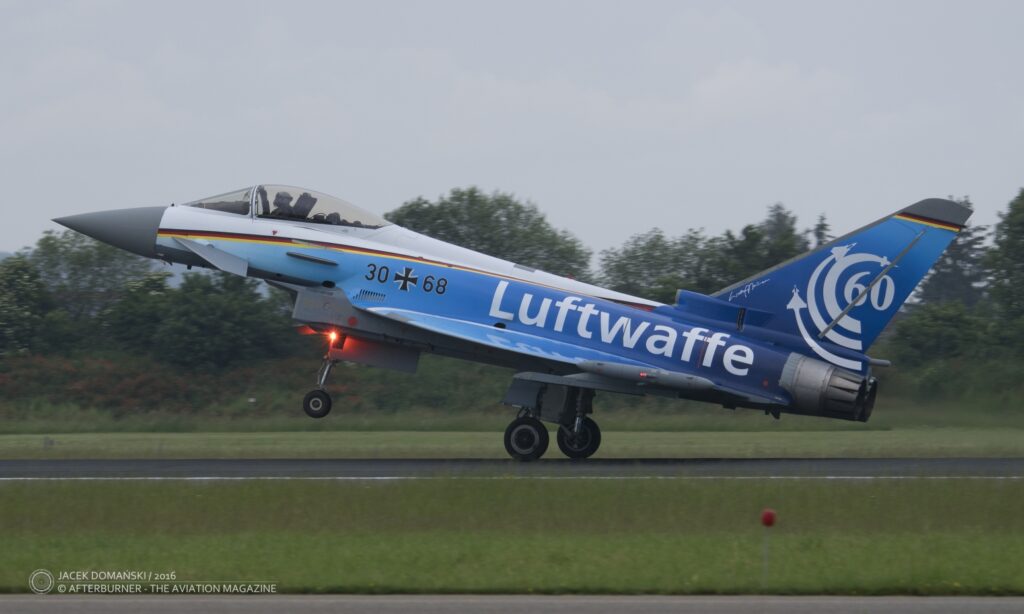
On 5 May 2021, Taktisches Luftwaffengeschwader 74 (the 74th Tactical Air Force Wing), commonly known as the “Bavarian Tigers”, celebrated its 60th anniversary. Formerly known as Jagdgeschwader 74 (the 74th Fighter Wing), the unit was founded in 1961 as the last fighter wing formed within the re-established German Air Force (Luftwaffe).
After the Second World War, as a consequence of a decision made by the Allied powers, German aviation activities were almost completely prohibited. The Luftwaffe was disbanded, and the initial idea was that the country would never again possess any military aviation.
The following years, however, proved that this was only a short-lived intention. In 1949, due to changing political circumstances and rising tensions between the former Allies, Germany was divided into two separate states, commonly known as West and East Germany. This marked the first step towards the remilitarisation of the country on both sides of the border.
On the western side, the armed forces of the Federal Republic of Germany were established in 1955, immediately becoming part of NATO. In the following year, due to the increasing military threat from the Warsaw Pact countries, it was decided to recreate the German Air Force. As a result, the new Luftwaffe was officially established on 9 January 1956.
Although the first aircraft, the Republic F-84 Thunderstreaks, were delivered to the Luftwaffe as early as 1956, it was the Air Transport Wing 61, formed in 1957 at Erding Air Base, to officially became the first operational unit of the re-established German Air Force. The formation of fighter wings began in 1959, with Jagdgeschwader 71 (JG 71), based at RAF Ahlhorn and equipped with Canadair Sabre Mk 6 aircraft, to be the first one.
The fifth (of six initially planned) Luftwaffe fighter wing, Jagdgeschwader 75, was formed in October 1960. Its primary operational task was to provide all-weather and night interception duties; therefore, it was equipped with the F-86K Sabre Dog – an upgraded variant of the F-86 Sabre fitted with APG-37 radar. Later that same month, the unit was transferred to Leipheim Air Force Base.
Nevertheless, it soon became clear that the ambitious plan to create six fighter wings had to be abandoned due to a lack of financial resources. The originally planned Jagdgeschwader 74 was never established; instead, it was decided to relocate the already existing JG 75 to the recently reconstructed air base near Neuburg an der Donau and rename it JG 74.
The relocation to Neuburg was completed on 5 May 1961, and on that day JG 74 was officially declared an active fighter unit under the command of Oberst Fritz Wegner. One year later, on 1 July 1962, Jagdgeschwader 74 was formally incorporated into the NATO aviation structure.
In 1964, JG 74 received its first Lockheed F-104G Starfighter aircraft. These progressively replaced the F-86K jets, which were finally retired in 1966. However, although originally intended as a supersonic interceptor, the F-104 was predominantly used by European NATO countries in a fighter-bomber role, which regrettably resulted in a very poor safety record. In Germany alone, 292 aircraft were lost and 116 pilots were killed in accidents, earning the Starfighter the grim nickname of “Widowmaker”.
A major change came in 1974, when the first F-4F Phantom II landed at Neuburg. With the arrival of the new aircraft, the operational capabilities of Jagdgeschwader 74, as well as the scope of its tasks, were significantly enhanced.
On 5 May 1981, marking the unit’s 20th anniversary, eight F-4F Phantom II aircraft from JG 74 performed a seven-hour non-stop flight from Neuburg to Goose Bay Air Base in Canada (with air-to-air refuelling en route). It was the first flight of its kind since the re-establishment of the German Air Force in 1956. This marked the beginning of long-term international cooperation between JG 74 and other NATO units, including reciprocal air base visits and squadron exchanges.
Following the reunification of Germany, Jagdgeschwader 74 continued its operational duties. In the early 1990s, the unit’s Phantoms underwent the Improved Combat Effectiveness programme, significantly enhancing their combat capabilities. Around the mid-1990s, German airspace was divided into two sectors: JG 71 at Wittmund was responsible for air policing in the north, while JG 74 covered the southern part of the country.
Between July and September 2005, Phantoms of Jagdgeschwader 74 were deployed for the first time to the Baltic States as part of the NATO Air Policing mission. Since then, the unit has participated in Baltic Air Policing on a regular basis.
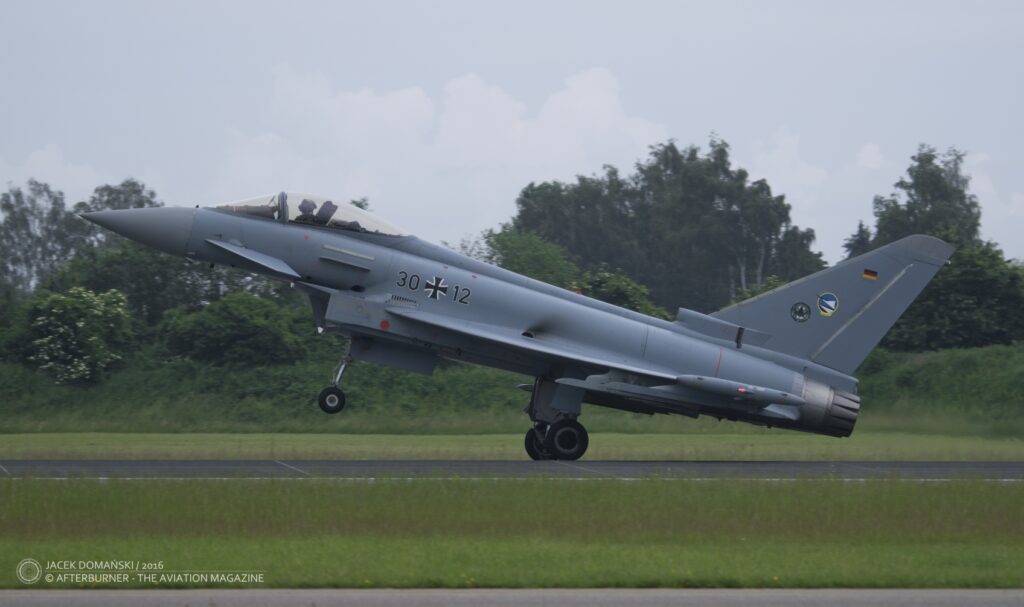
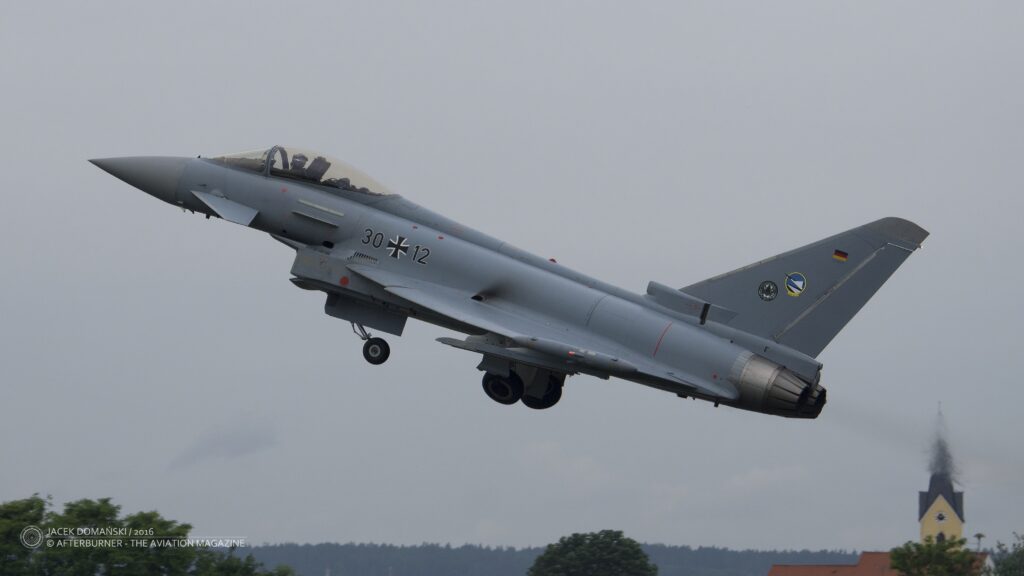
As nothing lasts forever, another generational change came in 2006, when Jagdgeschwader 74 had the honour of becoming the first operational Luftwaffe unit to receive the new Eurofighter 2000 aircraft. The introduction of these fourth-generation fighters took two years, and in June 2008 the EF 2000s at Neuburg became fully operational in the air defence role. At the same time, the Phantom aircraft were retired from active service.
In October 2013, as part of a structural reform of the German Air Force, JG 74 was redesignated as Taktisches Luftwaffengeschwader 74 (TaktLwG 74). Following the disbandment of Jagdbombergeschwader 32 – a Tornado-equipped unit based just 60 kilometres away – the Eurofighters from Neuburg were also granted access to Lechfeld airfield as a secondary base.
In the 1970s, in order to preserve and maintain tradition, Luftwaffe units were awarded honorary names of distinguished German pilots. Jagdgeschwader 74 received its honorary name on 22 November 1973, marking the 32nd anniversary of Werner Mölders’ death. It was the fourth such name awarded, after “Richthofen”, “Boelcke” and “Immelmann”. However, following a recommendation issued in 1998 by the German Bundestag, the Military History Research Office (Militärgeschichtliches Forschungsamt) conducted a study of Mölders’ service and deemed him unsuitable as a patron of a Luftwaffe operational unit, primarily due to his service in the Condor Legion. As a result, the honorary name was officially withdrawn in 2005 (although it remained in common informal use).
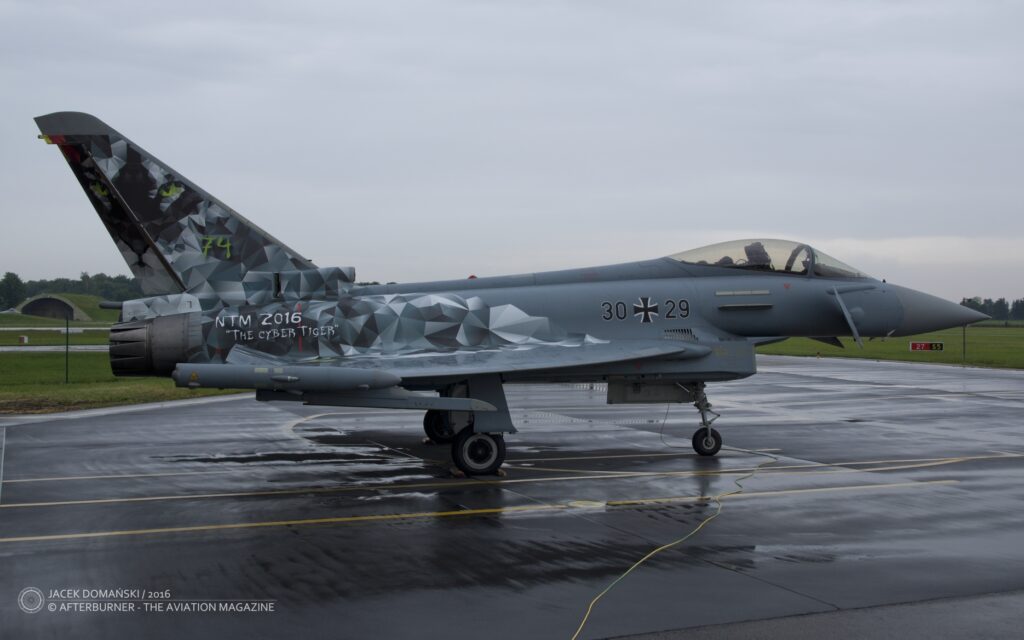
As previously mentioned, the 2013 structural reform of the Luftwaffe resulted in the disbandment of Jagdbombergeschwader 32. In addition to taking over responsibilities related to Lechfeld Air Force Base, TaktLwG 74 also inherited the Tiger traditions of JaBoG 32, which had been a full member of the NATO Tiger Association since 1994.
On 18 March 2013, during an official ceremony held at Neuburg, TaktLwG 74 formally assumed the “Tiger Spirit” from Jagdbombergeschwader 32, becoming the “Bavarian Tigers”. This proved to be an excellent decision, as Taktisches Luftwaffengeschwader 74 has since become a highly respected bearer of the Tiger tradition and one of the most active members of the NATO Tiger Association. Although initially granted probationary status, the unit achieved full membership in 2016.
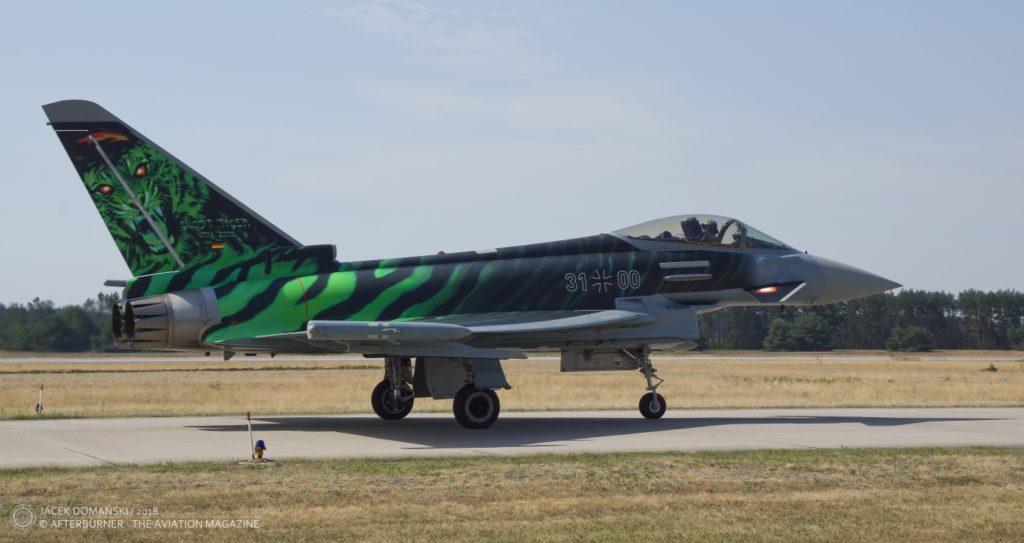
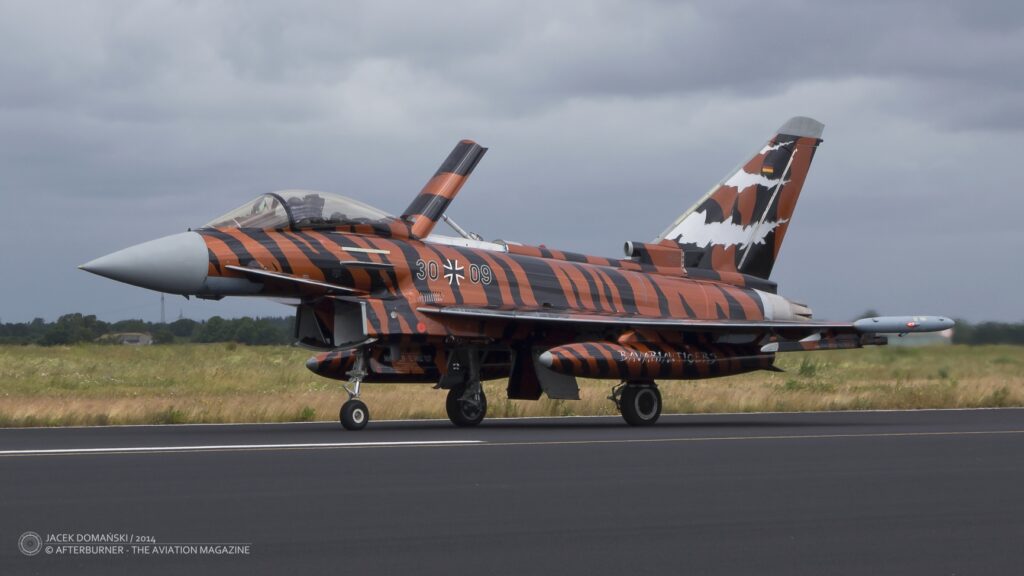
Each year, aviation enthusiasts eagerly anticipate a new special livery for the EF 2000. The “Bavarian Tigers” have repeatedly demonstrated their creativity in designing striking “tiger” paint schemes for the annual Tiger Meet exercise. Some have already achieved legendary status, such as the “Bronze Tiger” (2014), “Cyber Tiger” (2016), and “Ghost Tiger” (2018). The 2021 “Bavarian Tiger”, created to mark both the 60th anniversary of TaktLwG 74 and the fifth anniversary of full NATO Tiger Association membership, is yet another example of outstanding aircraft livery art.
The “Bavarian Tigers” also have an impressive record of organising open days at Neuburg Air Base, dating back to the early 1980s. These events are widely regarded as well-organised and engaging by both aviation enthusiasts and the general public, often attracting more than 100,000 visitors.
Also in 2021, to mark the two aforementioned anniversaries, TaktLwG 74 planned to host another public open day as part of the annual German Armed Forces event. Regrettably, the ongoing development of the coronavirus pandemic led to the cancellation of the celebration. It was subsequently announced that this year’s edition of Tag der Bundeswehr would once again be held online.