The German flying bomb, initially known as the Fieseler Fi 103 but then officially designated Vergeltungswaffe 1 (Vengeance Weapon No. 1), was developed in the early 1942 by Fritz Gosslau and Robert Lusser, who at that time worked for the Fieseler company.
In October of 1939, the Argus company introduced the idea of Fernfeuer (distant fire) proposed by Schmidt and Gosslau. It had to be a remote-controlled, unmanned aircraft, able to carry a payload of 1,000 kg and return to base after attacking a target. Finally, in February of 1942, Gosslau and Lusser drafted a design of a small, unmanned aircraft powered by a pulse-jet engine, mounted above the tail.
According to its creators, the flying bomb should be able to fly a distance of up to 300 kilometres at an average speed of 700 kph, with a payload of approximately 500 kilograms.These flight characteristics attracted attention of Reichsluftfahrtministerium (Reich Aviation Ministry – RLM), and, on 19 June 1942, the project was approved for further development. The flying bomb received a cover name Flakzielgerät 76 (target drone system 76), although it was officially designated as the Fieseler Fi 103.
The RLM had assigned engine development to Argus, while the fuselage of the flying bomb had to be designed by Fieseler and its guidance system by Askania. The first flight of the new aircraft took place on 10 December 1942, when the Fi 103 was dropped from a Focke-Wulf FW 200 “Condor” aeroplane. On 26 May 1943, the flying bomb was approved for serial production.

However, the serial production of the Fi 103 began almost a year after the official approval – and for the first time the flying bomb was used only on 12 June 1944, within an Operation Eisbär. Nevertheless, it was reported that none of the Fi 103s launched on that day reached England, with only four doing so the next day The first successful attack was carried out on the night of 15/16 June, when 73 flying bombs reached London and other 53 hit their targets in Portsmouth and Southampton.
Approximately 10,000 of the Fi 103 unmanned aircraft were launched against the UK, 2,419 of them reached England, killing approximately 6,000 people and injuring another 18,000 – as officially reported by the Ministry of Home Security. About 2,000 V-1s were fired at Antwerp between October 1944 and March 1945, in an unsuccessful attempt to prevent the Allied forces to use a harbour there. Due to quick change of the front line and lack of large-area – and valuable enough – targets, no flying bombs were used operationally at the Eastern Front.
More about the V-1 in Fieseler Fi 103 and 13 June 1944 – the first V-1 flying bomb reaches England.
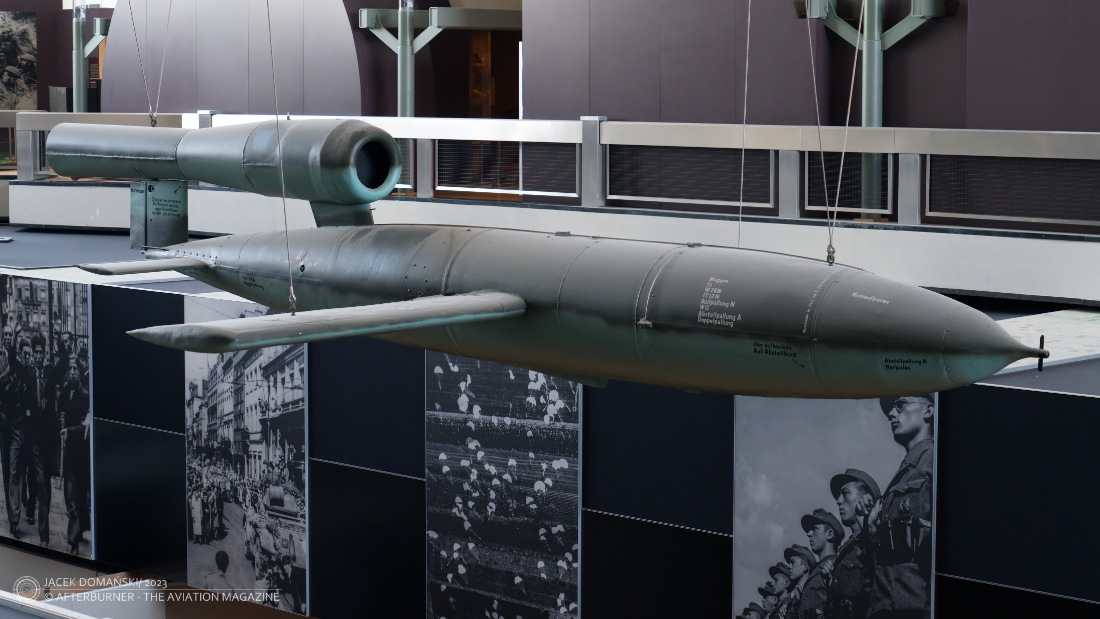
Cover photo: Fieseler Fi 103 in the Royal Museum of the Armed Forces and Military History, Brussels, Belgium (2023)