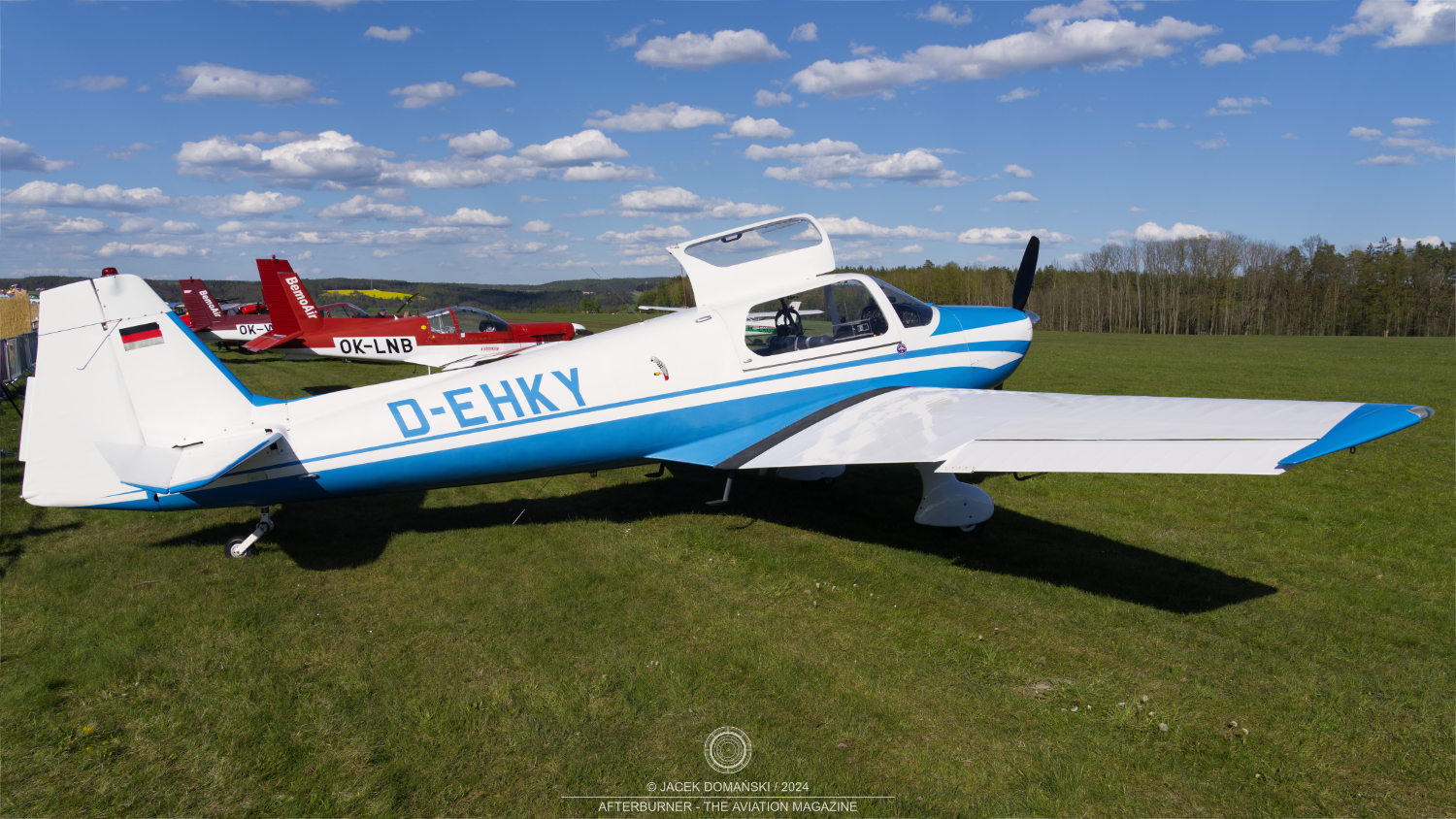
 Bölkow Bo 207 (c/n 272, D-EHKY), a visitor to Plasy airfield during the 2024 edition of Den ve vzduchu air show, Plasy, April 2024.
Klemm Leichtflugzeugbau GmbH (Klemm Light Aircraft Company Ltd.) was a German aircraft manufacturer founded in 1926 by Hanns Klemm. In the 1930s, the company gained worldwide recognition thanks to its successful sports and training aircraft, such as the Klemm Kl 25 (L 25) and Kl 35.
During the war, Klemm initially focused on manufacturing the aforementioned Kl 35 training aircraft later moving on to the licence-built Messerschmitt Me 163 rocket-powered fighter. Although the company’s chief designer, Carl Bucher, developed several interesting aircraft between 1939 and 1945, none of them progressed beyond the prototype stage. After the war, owing to the ban on designing and manufacturing aircraft in Germany, the company was closed.
In 1952, when the aforementioned ban was lifted, an opportunity arose to re-establish the company in cooperation with Ludwig Bölkow. Shortly afterwards, Klemm Light Aircraft was re-founded under the management of the founder’s son, Hanns-Jürgen Klemm. The first post-war development, known as the Klemm Kl 107, was based on Bucher’s 1938 design for a two-seat sports aircraft.
Nevertheless, the post-war existence of Klemm was relatively short-lived. In 1959, after several consecutive corporate transformations, Bölkow acquired all shares from Hanns-Jürgen Klemm and incorporated the company into his recently established enterprise, Apparatebau Nabern GmbH (later known as Apparatebau Bölkow GmbH).
Bölkow continued to work on the Kl 107 design. The latest variant of the aircraft, the three-seat Kl 107C, was developed into a four-seat aeroplane equipped with a more powerful engine. The first prototype, initially designated the Kl 107D, was built in Nabern and successfully completed its maiden flight on 10 October 1960.
Following the company’s name change, the aircraft was initially re-designated the Bölkow F.207. However, this was soon changed again, to the Bölkow Bo 207. In 1961, serial production of the new aircraft began at the new Bölkow plant in Laupheim.
Similarly to its predecessor, the Bölkow Bo 207 was a low-wing monoplane of wooden construction equipped with fixed conventional landing gear. However, it featured a wider cabin with a larger canopy and panoramic windows, as well as enlarged fuel tanks in the wings. The prototype was powered by a 179 hp Lycoming O-360-A1A four-cylinder engine.
The Bo 207 became one of the first serially produced post-war sports aircraft in Germany. A total of 92 examples were built by 1966, when production ceased. Although the aircraft was well received by customers, sales did not meet expectations. Consequently, several Bo 207s were built for stock and sold in subsequent years.
This was exactly the fate of the Bo 207 featured in our Photo of the Week series. Built in 1962, the aircraft remained in storage for about three years. In 1965, it was acquired by Flieger-Club Hannover e.V.
Over the years, this Bo 207 changed hands several times. In 2021, it was acquired by a new owner in the Netherlands who carried out a thorough overhaul of the aircraft. As the new owner was a former Dutch military pilot who had flown the F-104, the aircraft was marked with “Poly Grey”, the grey red-tailed parrot that served as the mascot of No. 322 Squadron of the Royal Netherlands Air Force.
However, the aircraft did not remain in the Netherlands for long. Since 2023, the Bo 207 has been based at Příbram, in the Czech Republic. It also appears that recently the aircraft was once again offered for sale (as of May 2026).