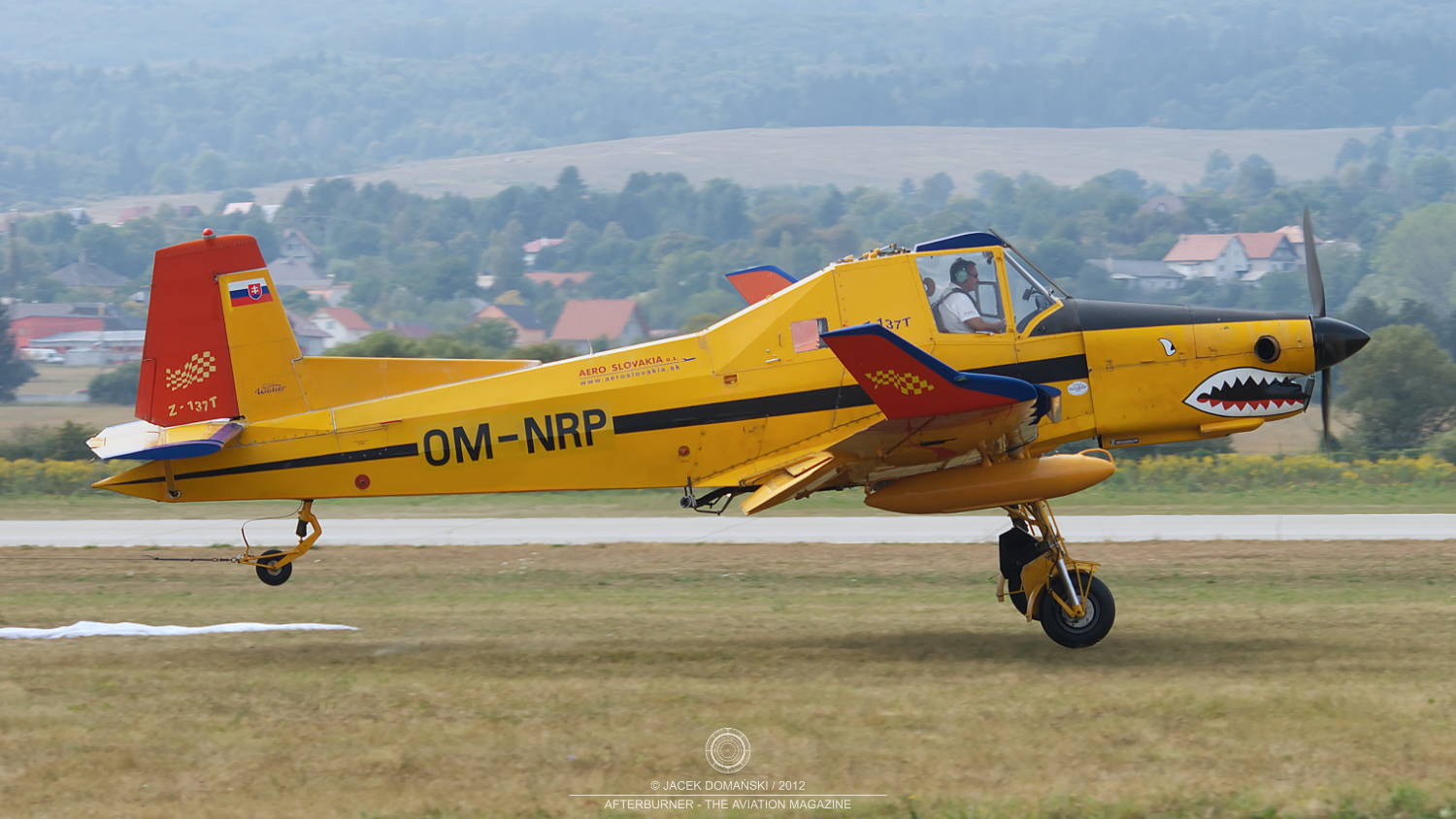
 Zlín Z-137T Agro Turbo (c/n 048, OM-NRP, operated by Aero Slovakia a.s.), used as a glider tug during the 2012 edition of the Slovak International Air Fest (SIAF), Sliač, September 2012.
On 29 June 1963, the prototype of a new Czechoslovak crop-dusting aircraft, designated the XZ-37, performed its maiden flight.
The aeroplane was developed by Let Kunovice and Moravan Otrokovice, two well-known Czechoslovak aviation manufacturers, following a competition to develop a standardised crop-dusting aircraft for the Comecon (Council for Mutual Economic Assistance) countries.
The new agricultural aeroplane was an all-metal cantilever low-wing monoplane with fixed landing gear and a tailwheel. The pilot’s cockpit was situated directly above the engine. Behind the cockpit there was the chemical hopper, followed by a seat for a mechanic with a small side window. The XZ-37 was initially powered by a 260 hp Ivchenko AI-14 radial engine, but the aircraft proved to be underpowered. Eventually, it was fitted with the Avia M-462RF powerplant – a licence-built variant of the AI-14, modified to produce 315 hp.
It should be mentioned that there have been speculations that the general design of the aeroplane was copied from the Auster B8 Agricola, a British agricultural aircraft from 1955 that never achieved commercial success. Nevertheless, these claims have never been confirmed or proven.
In 1965, serial production of the Z-37 Čmelák (Bumblebee), as the aircraft was officially named, was launched. Depending on the manufacturer, the aeroplanes were usually designated either Zlín or Let, indicating their origin from Otrokovice or Kunovice respectively. The Z-37 was widely used in the former Czechoslovakia and was also exported to many other European countries.
Although the Z-37 gained recognition throughout the world, it was never destined to become the standard crop-dusting aircraft for the Comecon countries. As was often the case within the former Eastern Bloc, the idea collapsed almost as quickly as it had been created. Most notably, Poland and the Soviet Union – initially expected to become the largest operators of the aeroplane – never approved the Z-37 design and instead began developing their own agricultural aircraft.
In Poland, this quickly led to the creation of two renowned designs, the PZL-106 Kruk and the PZL-Mielec M-18 Dromader. The latter performed its maiden flight in 1976 and soon became so successful that the Comecon ordered the cessation of further Z-37 production. From 1977 onwards, Čmelák was to be replaced by the M-18 as the standard crop-dusting aircraft of the Eastern Bloc.
On the other hand, the M-18 was not accepted by Czechoslovak operators, particularly SlovAir – the country’s largest company specialising in aerial application and other aviation services. From that point, it was only a small step towards launching the development of a turboprop-powered variant of the Z-37, initially known as the XZ-37T Čmelák Turbo.
The idea of “turbočmelák” was not new. The first plans to use the then newly developed Czechoslovak Walter M-601 turboprop engine to power an agricultural aircraft date back to 1971. In 1976, there were even attempts to install the M-601 in the Z-37. However, following the aforementioned Comecon decision, further work on the project was cancelled.
Nevertheless, the concept returned in 1981, and the first prototype of the XZ-37T was soon completed. Compared with the original design, the aircraft’s rear fuselage had been extended by 0.8 metres and it was now powered by a 690 hp M-601B engine. On 6 September 1981, the prototype successfully performed its maiden flight.
Interestingly, the XZ-37T prototype built at the Kunovice plant was used solely as a technology demonstrator. As it was considered too expensive to install such systems before the aircraft had been properly evaluated, the aircraft was not equipped with any crop-dusting equipment.
A short time later, a second prototype was completed. This aircraft was equipped with a 485 hp M-601Z powerplant and featured new, longer-span wings fitted with winglets. The second prototype performed its maiden flight on 12 July 1983.
The final prototype of the turboprop crop-duster was developed in Otrokovice. Officially designated the Z-37T Agro Turbo, it took to the skies for the first time in December 1983.
However, before “turbočmelák” was approved for serial production, several modifications were introduced. As a consequence, the production version was redesignated the Z-137T. The aeroplane was then built in a short production run of approximately fifty examples, all of which were intended for the domestic market. Later, two prototypes of a two-seat variant were developed, but the type was never approved for mass production.
The story of the Z-137T also has one unusual chapter. Following a request from the military authorities of the German Democratic Republic, one “turbočmelák” was converted into a prototype light attack aircraft. Designated the Z-37TM, the aircraft performed its maiden flight in 1985 before being delivered to East Germany. Its further service within the GDR remains unknown. However, during the 2010s, the wreckage of the prototype was discovered in Hungary, having once again been converted into an ordinary crop-dusting aircraft.
More information about the Z-37 aircraft can be found in one of our previous articles, Let Z-37A-C3 Čmelák.