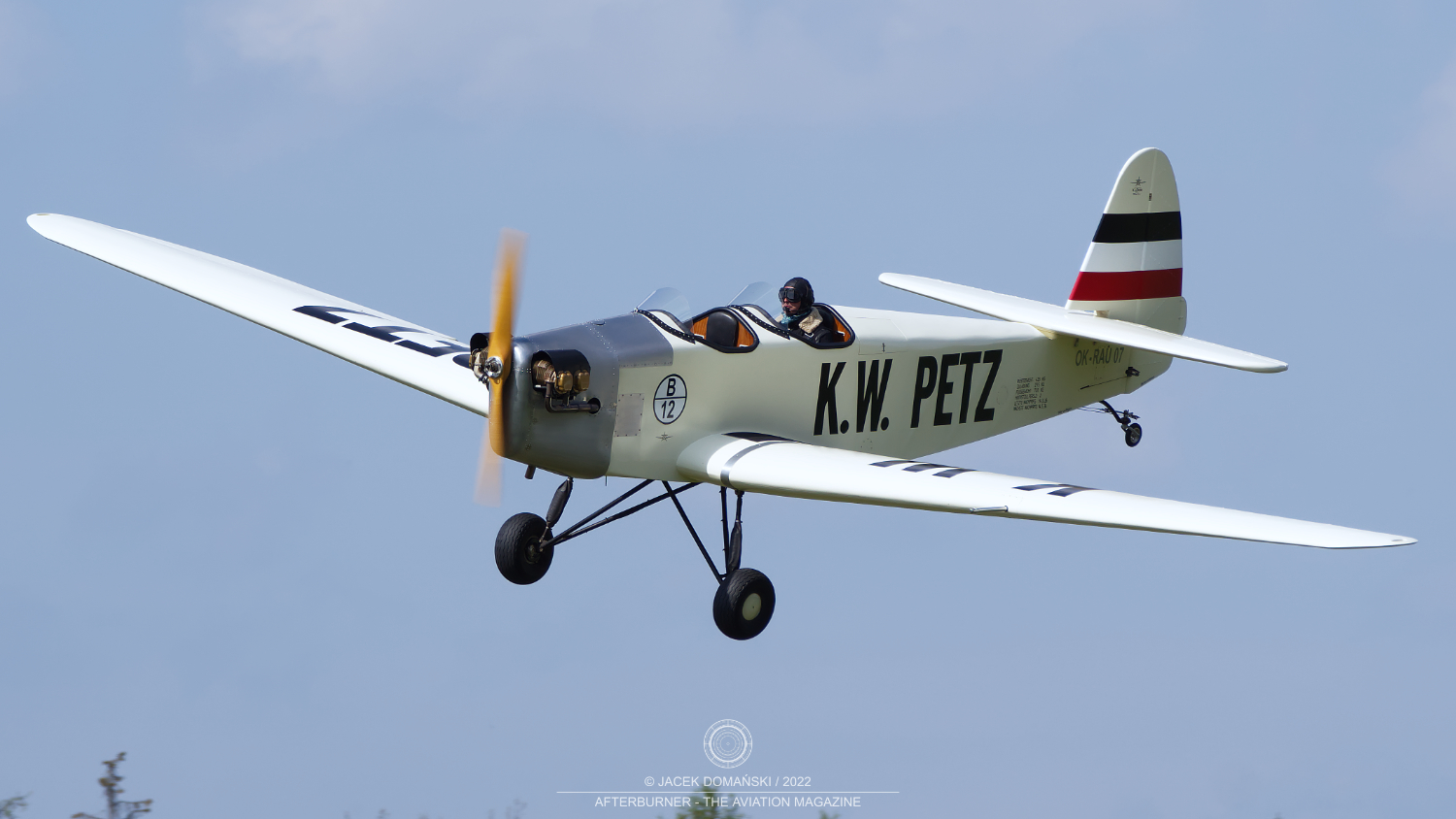
 Klemm L 25H (full-scale replica, OK-RAU 07), flying display during the 2022 edition of Den ve vzduchu air show, Plasy, April 2022.
In 1926, Hanns Klemm, a German aviation engineer who had previously worked for Zeppelin and Daimler, founded his own aircraft manufacturing company, Klemm Leichtflugzeugbau GmbH (Klemm Light Aircraft Company Ltd.).
The company began its activities by manufacturing the L 20, a two-seat light aircraft Klemm had developed during his time at Daimler. Although the aircraft was well received by the market, Daimler was reluctant to launch it into serial production. Confident in the merits of his design, Klemm decided to manufacture the aeroplane independently.
Shortly after establishing his company, Klemm asked Robert Lusser, then a young aircraft designer, to work on his first independent project, designated the L 25. The new aircraft was to be based on the L 20 while following Klemm’s concept of a lightweight, compact, low-powered and affordable sports and training aeroplane suitable for a wide range of customers.
Nevertheless, Lusser opted for a more powerful aircraft. Instead of the 20 hp Daimler engine used in the L 20, he proposed fitting the new design with a 50 hp French-built Salmson AD9 engine. The first prototype was completed in early 1928 and performed its maiden flight in April of that year, although it was still powered by the Daimler engine. The more powerful version followed shortly afterwards, and Klemm soon began offering both variants to customers.
The Klemm L 25 (later redesignated the Kl 25) was a low-wing cantilever monoplane with an open, tandem two-seat cockpit and fixed conventional landing gear. It featured an all-wooden structure with a plywood-covered airframe. Depending on the version, the aircraft had a maximum take-off weight of between 620 and 720 kg and a top speed of up to 160 kph.
The new aircraft proved to be a commercial success. Serial production began in 1928, and the L 25 was purchased by numerous flying clubs and private owners in Germany and abroad. Within a short time, the aeroplane came to dominate German sporting aviation competitions and became renowned for numerous long-distance and challenging flights.
Its first major success came in June 1928, when Lusser won Rheinisches Flugturnier in Düsseldorf. The following month, he claimed victory in the German national aerobatic championship. In September, he also triumphed in the French light aircraft competition in Paris.
In 1930, Ernst Udet, one of the top fighter aces of the First World War, successfully landed an L 25 on the 3,200-metre-high Trient Glacier near Mont Blanc. In August of the same year, Wolf Hirth, a German gliding pioneer, and Oskar Welle flew a Klemm aircraft to Iceland. In January 1931, Elly Beinhorn, a pioneering German female aircraft pilot, completed a 7,000-kilometre journey from Berlin to Bolama (now in Guinea-Bissau) in an L 25.
The Klemm L 25 was offered in numerous variants, including a three-seat version and a floatplane, and powered by a wide range of engines. It is believed that as many as fourteen different powerplants were used, with the Salmson AD9 and Hirth HM 60 being among the most popular.
In 1938, the L 25 (by then officially designated the Kl 25) was succeeded by Klemm’s new training aircraft, the Kl 35. However, production of the Kl 25 for export customers continued during the early years of the Second World War before finally ending around 1941. Approximately 600 examples of the L 25 / Kl 25 were built and served in both civil and military roles in numerous countries, including Germany, Bolivia, Finland, Hungary, Peru, Romania, South Africa, Sweden, the United Kingdom and the United States.
The full-scale replica of the Klemm L 25H featured in our Photo of the Week series was built in the Czech Republic for the Metoděj Vlach Foundation. After five years of construction, the aircraft performed its maiden flight in 2012.
The Czech-built L 25H is powered by a 65 hp Continental A65 four-cylinder, air-cooled piston engine. It represents an L 25 fitted with a Hirth engine, hence the suffix “H”. The aircraft is owned and operated by Letecké muzeum Metoděje Vlacha (Metoděj Vlach Aviation Museum) in Mladá Boleslav.